French
Portuguese
Russian
German
Spanish
Japanese
Korean
Irish
Greek
Turkish
Italian
Danish
Romanian
Indonesian
Czech
Afrikaans
Swedish
Polish
Basque
Catalan
Esperanto
Hindi
Lao
Albanian
Amharic
Armenian
Azerbaijani
Belarusian
Bengali
Bosnian
Bulgarian
Cebuano
Chichewa
Corsican
Croatian
Dutch
Estonian
Filipino
Finnish
Frisian
Galician
Georgian
Gujarati
Haitian
Hausa
Hawaiian
Hebrew
Hmong
Hungarian
Icelandic
Igbo
Javanese
Kannada
Kazakh
Khmer
Kurdish
Kyrgyz
Latin
Latvian
Lithuanian
Luxembourg
Macedoniar
Malagasy
Malay
Malayalam
Maltese
Maori
Marathi
Mongolian
Burmese
Nepali
Norwegian
Pashto
Persian
Punjabi
Serbian
Sesotho
Sinhala
Slovak
Slovenian
Somali
Samoan
Scots Gaelic
Shona
Sindhi
Sundanese
Swahili
Tajik
Tamil
Telugu
Thai
Ukrainian
Urdu
Uzbek
Vietnamese
Welsh
Xhosa
Yiddish
Yoruba
Zulu
Excavators are easy to be used in large or small projects, and their working environment is generally messy and bumpy, so failures often occur, ranging from misalignment of the excavator's crawler to a problem with its hydraulic system. Today, Elephant Fluid Power mainly briefly describes the working principle of the excavator hydraulic pump to facilitate subsequent troubleshooting.
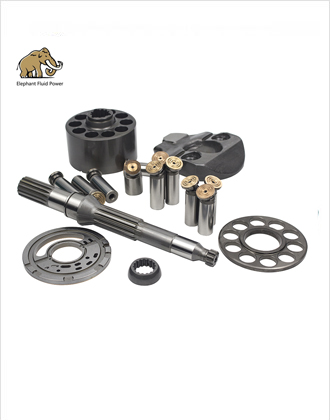
The working principle of the hydraulic pump is mainly composed of multiple plungers (usually an odd number, 9 are more, and there are other numbers), which are loaded into the cylinder body (also called the pump bladder) and are evenly distributed along the axis and the plunger. in the same number of holes. The slipper on the plunger is then pressed against the swashplate with an inclined angle to the plane of the cylinder. When the entire cylinder block and the plunger rotate, when the plunger rotates to the farthest distance from the swash plate to the cylinder block, a space will be drawn between the plunger and the bore of the cylinder block. The space between the channels is minimal. It is quite the same plunger that reciprocates the piston movement between the corresponding holes when it is pulled out and inserted. As long as the valve plate is used, the oil suction port is arranged at the corresponding position where the swash plate is farthest from the cylinder body, and the oil outlet is arranged at the corresponding position where the swash plate is closest to the cylinder body. Suction and discharge of oil, thereby generating the power required for the operation of the machine. In addition, the boom and the forearm do not have the boom hydraulic pump and the forearm hydraulic pump alone. They and other actions such as buckets, walking, and swinging are provided by the same or two identical parallel or series pumps. (some small excavators may be used for gear pump oil supply during rotation).
It is necessary to remind everyone that understanding the of the excavator hydraulic pump working principle does not mean that it can be completely repaired by itself. It is a high-precision part. For the sake of prudence, it is recommended that you consult a more professional person for consultation. Professional staff welcome your inquiries. In addition to providing consulting services, we can also provide all types of hydraulic solutions, and a variety of hydraulic pumps are waiting for you to choose.
hydraulic hand pump working principle
heavy equipment hydraulic pump operation
hydraulic gear pump working principle
hydraulic pump working video
hydraulic oil pump
hydraulic motor working principle
construction of hydraulic pump