Excavator pump is the core component of the excavator hydraulic system, its role is to convert the engine's mechanical energy into hydraulic energy, and then through the hydraulic motor and hydraulic cylinder will be converted back to mechanical energy, for the excavator's various actions (such as walking, rotating, digging, etc.) to provide power.
First, types and characteristics
1. Gear pumps:
Structure: rely on the rotation of gears to transport liquid, simple structure, relatively low price.
Applicable scenes: generally applicable to low and medium pressure systems, in some small excavators or auxiliary systems that do not require high pressure is more common. For example, it may be used in the excavator pilot system to provide control pressure for the operating handle.
2. Piston pump:
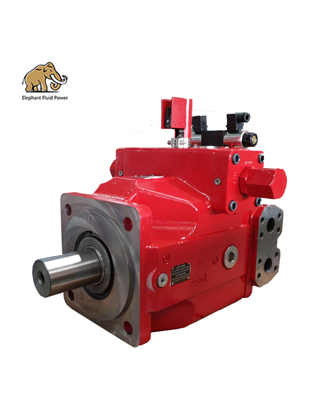
Structure: through the plunger reciprocating movement in the cylinder to realize the oil suction and pressure, can be divided into axial piston pumps and radial piston pumps. It has the advantages of high pressure, large flow, high efficiency and good variable performance.
Scenario: widely used in the main hydraulic system of all kinds of large and medium-sized excavators, which can meet the demand for power under different working conditions, such as digging, lifting heavy loads and other operations.
3. Vane pump:
Structure: It relies on the sliding of the vane in the rotor groove to change the volume of the working chamber, so as to realize oil suction and pressure. Vane pump is characterized by even flow, smooth operation and low noise.
Scenario: It is used in excavators with high requirements for work stability and noise control, but because its pressure is generally not as high as that of piston pumps, it is usually not used as the main pump, but more often used in auxiliary systems.
Second, Excavator Pump Working Principle
1.Gear pump
Structure: mainly consists of a pair of mutually meshing gears, pump body, end cover and other components. The gears are installed on two parallel shafts, one of which is driven by the engine, which in turn rotates the two gears.
Working Principle
Suction Process: When the gears begin to rotate, on the disengaged side of the gears, which is the suction chamber, the volume of the chamber gradually increases due to the teeth of the gears gradually withdrawing from meshing, forming a local vacuum. Under the action of atmospheric pressure, the hydraulic oil in the tank will be sucked into the suction chamber through the oil pipe.
Oil pressure process: As the gear continues to rotate, the inhaled hydraulic oil will be carried between the teeth to the discharge chamber. In the discharge chamber, the gears into the mesh state, so that the volume of the chamber is gradually reduced, the hydraulic oil is squeezed, the pressure rises, so that the hydraulic oil will be discharged from the pump body, transported to the excavator's hydraulic system, for the implementation of components (such as hydraulic cylinders, hydraulic motors) to provide power.
2. vane pump
structure: mainly by the stator, rotor, vane, oil distribution disk and pump body and so on. There is a certain eccentricity between the rotor and stator, and the vane is installed in the groove of the rotor, and can slide flexibly in the groove.
Working principle
Oil suction process: when the rotor rotates, the vane is tightly attached to the inner surface of the stator under the action of centrifugal force and oil pressure at the bottom. In the oil suction area of the rotor, due to the action of the curve of the inner surface of the stator, the blades gradually extend, so that the sealing volume between the two neighboring blades gradually increases, forming a local vacuum, and the hydraulic oil in the tank enters into these sealing volumes through the suction port under the action of atmospheric pressure.
Oil pressure process: As the rotor continues to rotate, the blades enter the oil pressure area. In the oil pressure area, the curve of the inner surface of the stator so that the vane is gradually retracted, the sealing volume is gradually reduced, the hydraulic oil is squeezed, the pressure rises, through the pressure port out of the pump body, into the hydraulic system.
3. Piston pump
Structure: axial piston pumps and radial piston pumps, axial piston pumps, for example, mainly consists of cylinder, piston, oil distribution plate, swash plate (or cam) and so on. Multiple plungers are evenly distributed on the circumference of the cylinder, and the plunger can make reciprocating motion in the plunger hole of the cylinder.
Working Principle
Oil Suction Process: When the engine drives the cylinder block to rotate, due to the action of the swash plate (or cam), the plunger reciprocates in the plunger hole of the cylinder block. In the suction process, the plunger extends outward, so that the sealing volume in the plunger hole gradually increases, forming a local vacuum, and the hydraulic oil in the tank enters the plunger hole through the suction window on the oil distribution plate.
The hydraulic oil in the oil tank enters the plunger hole through the suction window on the oil distribution plate. As the cylinder continues to rotate, the plunger retracts inwardly under the action of the swash plate (or cam), the sealing volume in the plunger hole gradually decreases, the hydraulic oil is squeezed, the pressure rises, and the hydraulic oil is discharged out of the pump body through the oil distribution plate's oil distribution window to be transported to the hydraulic system.
Third, maintenance points
1. Regular replacement of hydraulic oil: hydraulic oil is the key to the normal operation of the excavator pump, which not only plays a role in transmitting power, but also play a role in lubrication and heat dissipation of the internal parts of the pump. Regular replacement of hydraulic oil can prevent oil contamination resulting in increased wear and tear of the internal parts of the pump.
2. Check the filter: the filter can filter the impurities in the hydraulic oil to ensure that the oil into the pump clean. To regularly check the status of the filter, such as clogging should be cleaned or replaced in a timely manner.
3. Prevent air entry: the hydraulic system into the air will lead to pump noise, vibration, and even damage to the internal parts of the pump. In the daily maintenance should pay attention to check the sealing of the system to avoid air entry.
4. Control the working temperature: too high a working temperature will cause the viscosity of the hydraulic oil to drop, reducing the efficiency of the pump, but also accelerate the oxidation of the oil and the wear and tear of the parts. To ensure that the excavator's cooling system works properly, control the pump's operating temperature within the appropriate range.
Best hydraulic pump for excavators
Excavator hydraulic pump types
Excavator hydraulic pumps
 French
 Portuguese
 Russian
 German
 Spanish
 Japanese
 Korean
 Irish
Irish
 Greek
Greek
 Turkish
 Italian
 Danish
 Romanian
 Indonesian
 Czech
Czech
 Afrikaans
 Swedish
 Polish
 Basque
 Catalan
 Esperanto
 Hindi
Hindi
 Lao
Lao
 Albanian
 Armenian
 Azerbaijani
 Belarusian
 Bengali
 Bosnian
 Bulgarian
 Cebuano
 Chichewa
 Croatian
 Dutch
Dutch
 Estonian
 Finnish
 Galician
 Georgian
 Haitian
 Hebrew
 Hmong
Hmong
 Hungarian
 Icelandic
 Javanese
 Kazakh
 Khmer
Khmer
 Latin
Latin
 Latvian
 Lithuanian
 Luxembourg
 Macedoniar
 Malagasy
 Malay
Malay
 Maltese
 Maori
Maori
 Mongolian
 Burmese
 Nepali
 Norwegian
 Pashto
 Persian
 Punjabi
 Serbian
 Sinhala
 Slovak
 Slovenian
 Somali
 Samoan
 Tajik
Tajik
 Thai
Thai
 Ukrainian
 Uzbek
Uzbek
 Vietnamese
 Welsh
Welsh
 Yiddish
 Yoruba