An Elephant Fluid Power Technical & Buyer's Guide — 2026 Edition
Executive Summary
Parker Hannifin is the global leader in motion and control technologies, a Fortune-listed industrial powerhouse founded in 1918 that generated $19.9 billion in fiscal 2025 sales (Parker Hannifin, VectorShift). Parker's hydraulic division produces some of the most widely deployed piston pumps and motors on earth: the PV series variable pumps that set the industry standard, the PVP/PVM and PAVC workhorses of industrial hydraulics, and the legendary F11/F12 bent-axis motors that power saw heads, pile drivers, forestry machinery, and marine winches. When these units wear out, equipment owners face a familiar dilemma: premium OEM pricing with extended lead times, or high-quality aftermarket Parker hydraulic pump parts that are fully interchangeable with genuine components at a fraction of the cost.
This white paper maps the complete landscape of Parker hydraulic pump replacement parts — seven series covering more than fifty frame sizes from the compact F11-005 to the heavy PV270 and F12-250 — and explains how Elephant Fluid Power delivers stable quality, complete interchangeability with genuine Parker components, fast delivery, and reasonable pricing to repair shops, distributors, and fleet operators worldwide.
Key findings at a glance:
The global hydraulic components market was valued at 94.4 billion by 2035 at a 5.3% CAGR (Market Research Future).
Aftermarket F11/F12 repair kits typically cost 400 versus 1,500 OEM (60–70% savings); complete aftermarket PV pumps run 788 versus 3,000 OEM (Hydraulic Pump Supply).
Approximately 80% of Parker pump failures stem from contaminated hydraulic fluid causing scoring and wear — meaning most failures are repairable with quality rotating-group parts rather than full replacement (Hydraulic Pump Supply).
Machine downtime costs 500+ per hour, while OEM lead times for main hydraulic pumps can reach 6–20 weeks — making stocked aftermarket parts the economically rational choice (Huilian Machinery, Excavator Accessories).
1. The Parker Legacy: A Century of Motion & Control Leadership
1.1 From Cleveland machine shop to global hydraulics leader
Founded in Cleveland, Ohio in 1918, Parker Hannifin has grown into the undisputed #1 company in the motion and control industry, with fiscal 2025 sales of **3.5 billion, and an EBITDA margin of 27.3% (VectorShift, Parker Hannifin). The company's diversified portfolio spans motion systems (17% of revenue), flow and process control (23%), filtration and engineered materials (29%), and aerospace (31%) — a breadth built through both product innovation and landmark acquisitions (MarketScreener).
Within hydraulics specifically, Parker's piston pump and motor families have become de facto industry standards. The PV series "represents the industry standard for variable displacement axial piston pumps in mobile and industrial hydraulic applications," while the F11/F12 bent-axis series has defined the high-speed, high-pressure fixed motor category for decades (Hydraulic Pump Supply). Parker units are engineered into equipment across construction, agriculture, forestry, mining, marine, material handling, oil & gas, and industrial machinery worldwide — an installed base of extraordinary scale.
1.2 Why Parker pumps dominate both mobile and industrial hydraulics
Unlike brands concentrated in a single vertical, Parker's portfolio spans the full spectrum of hydraulic duty. The F11 series (5–19 cc, up to 14,000 rpm, 350 bar continuous / 420 bar intermittent) serves high-speed applications from forestry saw motors to fan drives; the F12 series (30–250 cc, up to 500 bar intermittent, 7,300 rpm) handles heavy-duty drives in mining, marine, and pile-driving equipment (GS Global Resources, Western Intech). The PV series covers variable-displacement open-circuit duty from 16 cc to 270 cc, and the PAVC series is a fixture of industrial presses, aluminum extruders, and steel mills (Hydraulic Pump Supply, Konglong Hydraulic).
The aftermarket consequence is decisive: because Parker units appear across so many machine types and industries, demand for Parker hydraulic pump spare parts is broad, deep, and continuous. The distinctive 40° bent-axis design of the F11/F12 — with its spherical pistons, laminated piston rings, timing gear synchronization, and heavy-duty roller bearings — creates a specific, well-defined wear-parts profile that quality aftermarket manufacturers can serve with complete fidelity (Phoenix Hydraulics).
2. Market Context: The Economics of Parker Pump Repair
2.1 A structurally growing hydraulic aftermarket
The demand environment for hydraulic replacement parts is exceptionally strong. The global hydraulic components market grew from 56.31 billion in 2025 and is forecast to reach $94.4 billion by 2035 — a 5.3% compound annual growth rate (Market Research Future).
The aftermarket is outgrowing the equipment market itself. The construction equipment aftermarket reached 40.39 billion by 2030, powered by a global fleet whose average age of **8.7 years structurally favors repair over replacement (The Business Research Company, Stats Market Research). Parker's cross-industry presence — construction, agriculture, forestry, mining, marine, industrial presses — means its aftermarket demand draws on several growth curves simultaneously.
2.2 The pricing structure favors repair with quality parts
The Parker aftermarket's published pricing makes the repair economics explicit. Aftermarket F11/F12 repair kits trade at 400 against 1,500 for OEM; PV140/PV180 parts run 400 aftermarket versus 1,200 OEM; complete aftermarket PV pumps cost 788 versus 3,000 OEM; seal kits are 100 versus 300 OEM — typical savings of 50–70% across every category (Hydraulic Pump Supply).
Critically, approximately 80% of Parker pump failures stem from contaminated hydraulic fluid causing scoring and wear in the rotating group — precisely the components contained in a repair kit — while catastrophic housing failures are comparatively rare (Hydraulic Pump Supply). This failure distribution means the large majority of Parker pump incidents are economically repairable with quality aftermarket rotating groups, seal kits, and bearings, provided the parts are dimensionally exact.
2.3 Downtime math: why lead time beats price
For buyers of hydraulic pumps and motors, the decisive purchasing criteria are availability and lead time first, then compatibility, cost, warranty, and brand reputation (Data Insights Reports). An idle machine costs 500+ per hour in lost production (Huilian Machinery), while OEM dealer lead times for main pumps can stretch to 6–20 weeks (Excavator Accessories). Even within the Parker channel, factory lead times on genuine F12 motors are commonly quoted at 8–10 weeks by air (NBSC Fluid) — an eternity for a down sawmill, pile driver, or winch.
Against this backdrop, a supplier holding stock of F11/F12 rotating groups or PV valve plates ships in days. The caveat — as always in the aftermarket — is supplier quality: mismatched low-grade components can add 15–20% in installation labor and trigger premature secondary wear (Langley Excavator Parts). Quality aftermarket parts "manufactured to OEM dimensions using quality materials" from factories specializing in Parker-compatible components are the documented standard for reliable results (Hydraulic Pump Supply). Section 4 details how Elephant Fluid Power meets that standard.
3. Complete Model Coverage: Seven Parker Series, Fifty-Plus Frame Sizes
3.1 The full Parker pump and motor range
Elephant Fluid Power stocks an extensive inventory of aftermarket replacement pump parts across seven Parker series, covering variable and fixed axial piston pumps and bent-axis motors (Elephant Fluid Power). The table below consolidates the complete range with verified technical and application context.
| Parker Series | Models Covered | Type | Technical & Application Notes |
|---|
| PV series | PV016 020 023 028 032 040 046 063 080 092 140 180 270 | Variable piston pump, open circuit | Industry-standard variable pumps; PV016–046 for compact equipment and auxiliary systems, PV063–100 for construction/agricultural primary circuits, PV140–270 (to 350 bar) for large excavators, mining equipment, and heavy presses (Elephant Fluid Power, Hydraulic Pump Supply) |
| PVP / PVM series | PVP16/23/33/38/41/48/60/76/100/140; PVM16/23/28/32/40/46/63/80/92 | Variable piston pump | Medium-duty variable pumps widely used across mobile and industrial hydraulics; PVM exported globally for steel mills, power plants, construction, mining, and injection molding (HZ Pump) |
| F11 series | F11-005 006 012 014 019 010 028 039 080 110 150 / 250 | Bent-axis fixed pump/motor | 5–19 cc small-frame units: speeds to 14,000 rpm, 350 bar continuous / 420 bar intermittent; CETOP, ISO, SAE versions (GS Global Resources, Focor Machinery) |
| F12 series | F12-030 040 060 080 110 125 150 / 250 | Bent-axis fixed pump/motor | 30–250 cc large-frame units: up to 500 bar intermittent, 7,300 rpm; ISO/SAE/cartridge versions; saw motors, pile drivers, marine winches, forestry drives (Western Intech, OstBridge) |
| V12 / V14 series | V12-060 080; V14-110 160 | Variable bent-axis motor | Variable-displacement bent-axis motors for fan drives, propel drives, and mobile machinery |
| P2 / P3 series | P2/P3-060 075 105 / 145 | Mobile variable piston pump | Compact mobile pumps for trucks, PTO drives, and vocational equipment (Elephant Fluid Power) |
| PAVC series | PAVC33 38 65 / 100 | Variable piston pump, pressure-compensated | Industrial fixtures: aluminum extruders, presses, stamping machines, cement and steel mill hydraulic systems; PAVC100 with through-drive to 2,600 rpm (Konglong Hydraulic) |
3.2 Anatomy of Parker wear parts: failure modes and the parts that fix them
Whether swashplate-type (PV, PVP, PAVC) or bent-axis (F11/F12, V12/V14), Parker units concentrate wear in a defined set of precision components. The documented symptom-cause-part matrix is remarkably consistent: external leakage traces to shaft seal failure; gradual pressure loss to valve plate wear; increased noise to bearing wear or cavitation; overheating above 85 °C to internal leakage in the rotating group; and metal particles in oil signal catastrophic internal failure requiring full rebuild (Hydraulic Pump Supply).
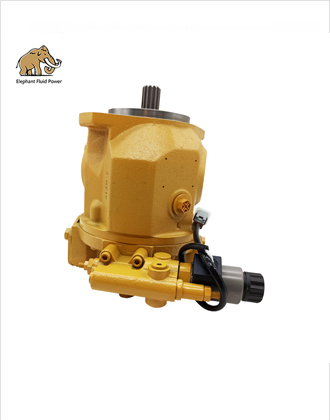
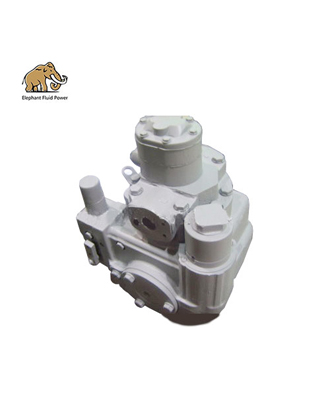
Elephant Fluid Power supplies every wear-critical component: cylinder block (cylinder barrel), piston (piston shoe), retainer plate, ball guide, valve plate, drive shaft, swash plate, plus bearings, timing gears, seal kits, and associated hardware (Elephant Fluid Power). For the F11/F12 specifically, correct aftermarket parts must replicate the signature engineering: laminated piston rings for low internal leakage and thermal shock resistance, spherical piston ends that stay seated under hydraulic and mechanical shock, the timing gear synchronizing shaft and barrel, and heavy-duty roller bearings for external shaft loads (Phoenix Hydraulics).
| Component | Function | Typical Failure Signature |
|---|
| Cylinder block / barrel | Houses pistons; rotates against valve plate | Scoring/wear → internal leakage, overheating |
| Pistons / piston shoes | Convert displacement angle to flow | Shoe/ring wear → noise, output drop |
| Valve plate | Directs inlet/outlet flow timing | Wear/cavitation → gradual pressure loss |
| Retainer plate & ball guide | Retain pistons to swashplate/thrust surface | Deformation → piston lift-off, scoring |
| Drive shaft | Transmits torque; carries seals | Spline wear, seal-journal scoring → leaks |
| Swash plate (PV/PVP/PAVC) | Sets displacement angle | Pitting → vibration, erratic compensation |
| Timing gear & roller bearings (F11/F12) | Synchronize barrel; carry shaft loads | Brinelling → whine, metal in oil |
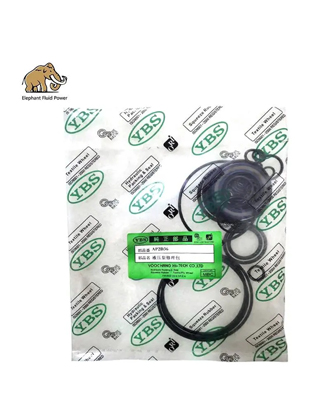
| Seal kits (FPM/Viton or NBR) | Contain pressurized oil | External leakage, contamination ingress |
4. The Elephant Fluid Power Difference: Stable Quality, Full Compatibility, Speed, and Fair Pricing
4.1 Stable quality through disciplined manufacturing
Every Parker replacement part from Elephant Fluid Power begins with the correct metallurgy — cast and ductile iron, alloy steel, and bronze matched to original specifications — and passes through a complete precision machining chain: cutting, CNC lathe work, machining centers, heat treatment, grinding, honing, and burring (Elephant Fluid Power). Process discipline is decisive for Parker parts: the F11/F12's spherical piston geometry and laminated piston rings operate at shaft speeds up to 14,000 rpm and intermittent pressures to 500 bar, while PV-series valve plates must sustain micron-scale oil films under 350 bar duty — tolerances achievable only through proper heat treatment, grinding, and honing.
All spare parts are produced in accordance with genuine parts drawings, and Elephant Fluid Power has earned extensive positive feedback from the global aftersales market on part quality and service (Elephant Fluid Power). This matches the documented reliability standard for the category: quality aftermarket Parker parts "manufactured to OEM dimensions using quality materials" and tested for fit and function deliver dependable results, while unverified budget parts do not (Hydraulic Pump Supply).
4.2 Complete interchangeability with genuine Parker components
Elephant Fluid Power's core technical commitment is stated plainly: its Parker replacement parts are completely interchangeable with the original pump (Elephant Fluid Power). Every dimension that matters — spline geometry to SAE/ISO/CETOP standards, port positions, bearing seats, valve-plate timing surfaces, and shaft seal journals — is manufactured to the genuine drawing, so a repair shop can install an Elephant rotating group, valve plate, or drive shaft into a genuine PV063, F12-060, or PAVC100 housing without modification or rework.
True interchangeability eliminates the hidden costs of low-grade sourcing — the 15–20% installation-labor penalty and premature secondary wear documented for mismatched parts (Langley Excavator Parts). For distributors, drawing-level compatibility also simplifies inventory: one Elephant rotating group serves every machine built on that Parker frame size, across all equipment brands and industries.
4.3 Fast delivery engineered around the downtime clock
With downtime costing 500+ per machine-hour and even genuine-channel lead times reaching 8–10 weeks on popular F12 motors, Elephant Fluid Power's operating model is built for speed: extensive stock across all seven Parker series, responsive order processing, and courier/air/sea freight options matched to each customer's urgency (Elephant Fluid Power, NBSC Fluid). The company's wider track record supports the promise — nearly 300,000 hydraulic units delivered to the US market in 2022 and active shipments to more than 80 countries.
For repair shops, that speed converts directly into won jobs: the shop that can return a customer's saw head, press, or excavator within days beats any competitor quoting factory lead times. For industrial plants and fleet operators, it converts into uptime.
4.4 Reasonable pricing and flexible branding
Elephant Fluid Power prices its Parker line at reasonable, aftermarket-appropriate levels — consistent with the documented 50–70% savings of quality aftermarket Parker parts versus OEM — without descending into the low-grade segment where premature failures erase the savings. Parts are available under the Elephant Fluid Power trademark, a neutral label, or the client's own private branding (Elephant Fluid Power).
The private-label option is strategically valuable for distributors: regional parts businesses can build their own brand equity on a proven manufacturing base with no upstream disclosure. Combined with low minimum-order flexibility, customization to client drawings, and direct factory communication via +86-180-3112-1586 or the Shijiazhuang, Hebei headquarters, Elephant Fluid Power operates as a manufacturing partner rather than a mere vendor.
5. Buyer's Guide: Identifying Your Parker Unit and Sourcing the Right Parts
5.1 How to identify your Parker pump or motor
Start with the nameplate, which carries the full Parker model code (e.g., F12-060-MS-SV-T-000-0000-P0, PV063R1K1T1NMMC, PAVC100R4222). Parker codes encode displacement, mounting standard, shaft type, seal material, rotation, and control options (Lifco Hydraulics).
Three practical cautions apply. First, F11 and F12 are not interchangeable despite similar appearance — they differ in frame size, internal components, and duty rating; always check the series designation on the nameplate (Hydraulic Pump Supply). Second, seal material matters: use FPM (Viton) seals for temperatures above 100 °C or synthetic/biodegradable fluids, and NBR for standard petroleum fluids (Hydraulic Pump Supply). Third, when the nameplate is illegible, provide the machine type, pump photos, and shaft/port measurements to Elephant Fluid Power's technical team for pre-sale verification.
5.2 Repair, rebuild, or replace: a decision framework
Industry guidance supports a clear rule: rebuild if the housing is intact and damage is limited to seals, bearings, or wear components — a typical rebuild costs 30–50% of new OEM pricing; replace if the housing is cracked, the shaft is damaged, or repair costs exceed 60% of a new pump (Hydraulic Pump Supply). Given that roughly 80% of Parker pump failures originate in fluid contamination affecting the rotating group, the rebuild path applies to the large majority of incidents.
Contamination discipline determines the outcome. After any Parker pump or motor repair, best practice is a full system flush, filter replacement, and oil analysis at the first service interval — proper filtration and fluid maintenance prevent most failures (Hydraulic Pump Supply, HW Part Store). Elephant Fluid Power supports all three paths: individual wear parts for targeted repairs, complete rotating-group and seal kits for rebuilds, and full component sets for professional remanufacturing.
5.3 OEM vs. premium aftermarket vs. budget parts: an honest comparison
| Decision Factor | OEM / Genuine Channel | Premium Aftermarket (Elephant Fluid Power tier) | Budget / Unverified Aftermarket |
|---|
| Upfront cost | Baseline: F11/F12 kit 1,500; PV pump 3,000 (Hydraulic Pump Supply) | 50–70% savings: F11/F12 kit 400; PV pump 788 | Lowest, but false economy |
| Lead time | Commonly 8–10 weeks (NBSC Fluid) | Days from stock | Variable |
| Fit & interchangeability | Guaranteed | Guaranteed to genuine drawings (Elephant Fluid Power) | Risky; +15–20% install labor (Langley) |
| Expected service life | Full OEM life | Comparable when manufactured to OEM dimensions and properly specified (Hydraulic Pump Supply) | Premature repeat failure risk |
| Best use case | Machines under factory warranty | Post-warranty equipment, wear components, urgent repairs, distributor resale | Not recommended for precision rotating groups |
The cross-industry consensus is a mixed-tier strategy: OEM where warranty demands it, premium aftermarket for high-volume wear components where savings compound fastest (Hubei Plus). Parker pump parts — with their defined wear-part profile and 80% contamination-driven failure pattern — sit squarely in the premium-aftermarket sweet spot.
6. Frequently Asked Questions (FAQ)
Q: Are Elephant Fluid Power Parker hydraulic pump parts compatible with genuine Parker pumps?
Yes. All Parker replacement parts are manufactured in accordance with genuine parts drawings and are completely interchangeable with original components — identical dimensions, SAE/ISO/CETOP spline and flange geometry, port configuration, and mounting interfaces, requiring no modification during installation (Elephant Fluid Power).
Q: Which Parker pump and motor models does Elephant Fluid Power cover?
Seven complete series: PVP16–140 and PVM16–92; PV016 through PV270; F11-005 through F11-250; F12-030 through F12-250; V12-060/080 and V14-110/160; P2/P3-060/075/105/145; and PAVC33/38/65/100 — more than fifty frame sizes across variable piston pumps and bent-axis fixed/variable motors.
Q: What are Parker F11 and F12 motors used for?
F11/F12 bent-axis motors and pumps serve high-speed, high-pressure applications in both open and closed circuits: forestry saw heads and debarkers, pile drivers and vibratory hammers, excavator swing drives, marine winches, municipal vehicles, grass and brush cutters, mining, oil & gas, and agricultural machinery (OstBridge, Western Intech).
Q: What is the difference between Parker F11 and F12 series?
F11 is the small-frame series (5–19 cc, up to 14,000 rpm, 350 bar continuous), while F12 is the large-frame series (30–250 cc, up to 7,300 rpm, up to 500 bar intermittent). Despite similar appearance they have different internal components and are not interchangeable — always check the nameplate (Hydraulic Pump Supply).
Q: What individual Parker pump spare parts are available?
Cylinder blocks/barrels, pistons with laminated rings, retainer plates, ball guides, valve plates, drive shafts, swash plates, timing gears, heavy-duty roller bearings, FPM/NBR seal kits, and all associated hardware — everything needed for targeted repair, full rebuild, or professional remanufacturing.
Q: How much can I save with aftermarket Parker hydraulic parts?
Documented savings run 50–70%: F11/F12 repair kits 400 vs. 1,500 OEM; PV140/PV180 parts 400 vs. 1,200; complete PV pumps 788 vs. 3,000; seal kits 100 vs. 300 (Hydraulic Pump Supply).
Q: Should I rebuild or replace my Parker hydraulic pump?
Rebuild if the housing is intact and damage is limited to seals, bearings, or rotating-group wear — a typical rebuild costs 30–50% of new OEM pricing. Replace if the housing is cracked, the shaft is damaged, or repair costs exceed 60% of a new pump (Hydraulic Pump Supply).
Q: Which seal material should I use for my Parker pump?
Use FPM (Viton) for operating temperatures above 100 °C or synthetic/biodegradable fluids; use NBR (Nitrile) for standard petroleum-based hydraulic fluids at normal temperatures. Elephant Fluid Power supplies both options.
Q: How fast is delivery?
Stocked Parker parts ship rapidly via express, air, or sea freight — a decisive advantage when genuine-channel lead times run 8–10 weeks and downtime costs 500+ per hour.
Q: Can I order private-label or neutral-label Parker parts?
Yes. Parts can carry the Elephant Fluid Power trademark, a neutral label, or the client's own branding — ideal for distributors building a regional parts brand.
7. Conclusion and Next Steps
Parker Hannifin's century of motion-and-control leadership has placed PV, PVP, PAVC, F11/F12, V12/V14, and P2/P3 units into one of the broadest installed bases in fluid power — spanning construction, agriculture, forestry, mining, marine, and industrial presses. With the global hydraulic components market growing toward $94.4 billion by 2035, the average equipment fleet now 8.7 years old, and documented aftermarket savings of 50–70%, the opportunity in quality Parker replacement parts is substantial and durable. The buyers who capture it partner with suppliers offering genuine-drawing interchangeability, disciplined manufacturing, deep seven-series stock coverage, fast delivery, and fair pricing.
Elephant Fluid Power delivers on every criterion. Whether you are a repair shop rebuilding an F12-060 saw motor, a distributor stocking PV063 rotating groups, or a plant maintenance team sourcing PAVC100 seal kits, Elephant Fluid Power's Parker hydraulic pump parts program provides the stable quality, full compatibility, fast delivery, and reasonable pricing your operation needs.
Contact Elephant Fluid Power today for a quotation or technical consultation:
Tel/WhatsApp: +86-180-3112-1586
Address: No. 398 Youyi Street, Xinhua District, Shijiazhuang City, Hebei, China
Product page: Parker Hydraulic Parts
 French
 Portuguese
 Russian
 German
 Spanish
 Japanese
 Korean
 Irish
Irish
 Greek
Greek
 Turkish
 Italian
 Danish
 Romanian
 Indonesian
 Czech
Czech
 Afrikaans
 Swedish
 Polish
 Basque
 Catalan
 Esperanto
 Hindi
Hindi
 Lao
Lao
 Albanian
 Armenian
 Azerbaijani
 Belarusian
 Bengali
 Bosnian
 Bulgarian
 Cebuano
 Chichewa
 Croatian
 Dutch
Dutch
 Estonian
 Finnish
 Galician
 Georgian
 Haitian
 Hebrew
 Hmong
Hmong
 Hungarian
 Icelandic
 Javanese
 Kazakh
 Khmer
Khmer
 Latin
Latin
 Latvian
 Lithuanian
 Luxembourg
 Macedoniar
 Malagasy
 Malay
Malay
 Maltese
 Maori
Maori
 Mongolian
 Burmese
 Nepali
 Norwegian
 Pashto
 Persian
 Punjabi
 Serbian
 Sinhala
 Slovak
 Slovenian
 Somali
 Samoan
 Tajik
Tajik
 Thai
Thai
 Ukrainian
 Uzbek
Uzbek
 Vietnamese
 Welsh
Welsh
 Yiddish
 Yoruba