French
Portuguese
Russian
German
Spanish
Japanese
Korean
Irish
Greek
Turkish
Italian
Danish
Romanian
Indonesian
Czech
Afrikaans
Swedish
Polish
Basque
Catalan
Esperanto
Hindi
Lao
Albanian
Amharic
Armenian
Azerbaijani
Belarusian
Bengali
Bosnian
Bulgarian
Cebuano
Chichewa
Corsican
Croatian
Dutch
Estonian
Filipino
Finnish
Frisian
Galician
Georgian
Gujarati
Haitian
Hausa
Hawaiian
Hebrew
Hmong
Hungarian
Icelandic
Igbo
Javanese
Kannada
Kazakh
Khmer
Kurdish
Kyrgyz
Latin
Latvian
Lithuanian
Luxembourg
Macedoniar
Malagasy
Malay
Malayalam
Maltese
Maori
Marathi
Mongolian
Burmese
Nepali
Norwegian
Pashto
Persian
Punjabi
Serbian
Sesotho
Sinhala
Slovak
Slovenian
Somali
Samoan
Scots Gaelic
Shona
Sindhi
Sundanese
Swahili
Tajik
Tamil
Telugu
Thai
Ukrainian
Urdu
Uzbek
Vietnamese
Welsh
Xhosa
Yiddish
Yoruba
Zulu
The A10VSO pump is a swashplate-type axial variable displacement piston pump commonly used in open-loop hydraulic systems. Below is a detailed explanation of its operating principle:
First, Basic Structure
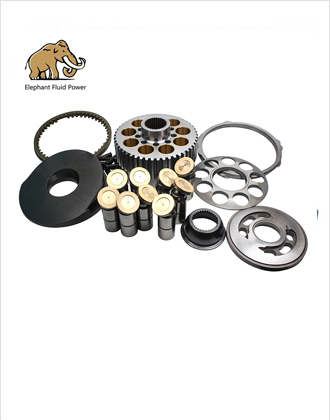
The A10VSO pump primarily consists of the pump housing, cylinder block, pistons, swashplate, distributor plate, drive shaft, and other components. The cylinder block is mounted within the pump housing and rotates driven by the drive shaft. Multiple pistons are evenly distributed within the piston bores of the cylinder block, capable of reciprocating motion within these bores. The swashplate is mounted at a specific angle relative to the cylinder block's axis. The distributor plate is fixed to the pump housing and positioned on one side of the cylinder block.
Second, Working Principle
1. Suction Process
When the prime mover drives the drive shaft to rotate, the cylinder block rotates accordingly. Due to the angle between the swash plate and the cylinder block axis, the plungers perform reciprocating motion within their bores while rotating with the cylinder block. As a plunger moves from the farthest point to the nearest point relative to the swash plate, the volume of its chamber gradually increases, creating a local vacuum. At this point, the suction port on the distributor plate connects to this piston chamber. Hydraulic fluid from the reservoir enters the piston chamber through the suction inlet and the distributor plate's suction port under atmospheric pressure, completing the suction process.
2. Pressure Fluid Process
As the cylinder continues rotating, the piston moves from the closest to the farthest point on the swashplate, gradually decreasing the volume of the piston chamber. At this point, the discharge port on the distributor connects to this piston chamber. The hydraulic fluid within the piston chamber is compressed, increasing pressure. The fluid then exits through the distributor's discharge port and the pump's outlet, entering the hydraulic system to supply pressurized oil, completing the discharge process.
3. Flow Regulation Principle
Flow regulation in the A10VSO pump is achieved by altering the swashplate's tilt angle. A larger swashplate angle increases the piston stroke per cylinder rotation, resulting in a larger volumetric change within the piston chamber. This, in turn, increases the pump displacement and output flow rate. Conversely, a smaller swashplate angle reduces both displacement and output flow. By adjusting the swashplate angle through the control mechanism, the pump achieves stepless flow regulation to meet varying hydraulic system flow demands under different operating conditions.
Third, Operational Characteristics Under Different Control Modes
The A10VSO pump supports multiple control modes, such as pressure control (DR) and load-sensing control (DFR). Taking pressure control as an example: when system pressure reaches the set value, the control mechanism automatically reduces the swashplate angle based on pressure feedback signals. This decreases the pump's output flow rate, matching the pump's output power to the system load. This achieves energy savings and protects the system.
Rexroth A10VSO series 31
A10VSO manual