French
Portuguese
Russian
German
Spanish
Japanese
Korean
Irish
Greek
Turkish
Italian
Danish
Romanian
Indonesian
Czech
Afrikaans
Swedish
Polish
Basque
Catalan
Esperanto
Hindi
Lao
Albanian
Amharic
Armenian
Azerbaijani
Belarusian
Bengali
Bosnian
Bulgarian
Cebuano
Chichewa
Corsican
Croatian
Dutch
Estonian
Filipino
Finnish
Frisian
Galician
Georgian
Gujarati
Haitian
Hausa
Hawaiian
Hebrew
Hmong
Hungarian
Icelandic
Igbo
Javanese
Kannada
Kazakh
Khmer
Kurdish
Kyrgyz
Latin
Latvian
Lithuanian
Luxembourg
Macedoniar
Malagasy
Malay
Malayalam
Maltese
Maori
Marathi
Mongolian
Burmese
Nepali
Norwegian
Pashto
Persian
Punjabi
Serbian
Sesotho
Sinhala
Slovak
Slovenian
Somali
Samoan
Scots Gaelic
Shona
Sindhi
Sundanese
Swahili
Tajik
Tamil
Telugu
Thai
Ukrainian
Urdu
Uzbek
Vietnamese
Welsh
Xhosa
Yiddish
Yoruba
Zulu
In concrete pump trucks, the A11VO is typically used as the main oil pump, responsible for driving the core delivery cylinder to perform high-pressure pumping. It is the most powerful and critical component in the truck’s hydraulic system.
1. Extreme Suction Capacity (VLO): During operation, concrete pump trucks run at high engine speeds with massive displacement. The A11VLO’s integrated centrifugal booster pump forces oil into the plunger chamber, preventing cavitation caused by air ingestion during high-speed pumping. This is essential for ensuring the pump truck can operate continuously for extended periods without pump failure.
2. Dual-Pump/Triple-Pump Series Configuration: Concrete pump trucks must simultaneously drive the delivery cylinder, placing boom, and mixing system. The A11VLO’s exceptional through-shaft drive capability allows two A11VLO190 or 260 units to be connected in series, forming a powerful dual-pump main circuit, with the option to add a gear pump at the end to drive the cooling system.
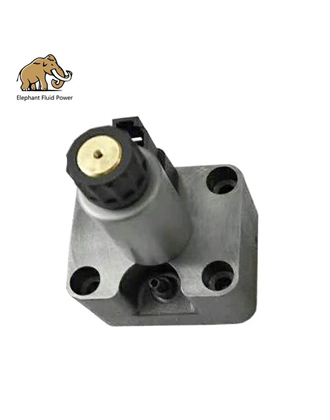
3. Precise Power Distribution (LRDU): The LRDU controller commonly used in concrete pump trucks (constant power control with unloading and stroke limiting).
Remote Unloading: During emergency pump shutdown or when switching to pump flushing mode, an electronic control signal can rapidly reduce the main pump’s displacement to zero.
Power Sharing: Ensures that during sudden increases in pumping pressure (such as pipe blockages), the main pump can quickly reduce its displacement to prevent engine stalling.
1. Heavy-duty concrete pump trucks (50-meter class and above): Standardly equipped with A11VLO190 or A11VLO260. Large concrete pump trucks from Sany and Zoomlion often use this type of dual-pump parallel configuration to achieve a concrete delivery rate of 120–180 cubic meters per hour.
2. Medium-duty concrete pump trucks/truck-mounted pumps: Most commonly use A11VLO130 or A11VO95.
1. Insufficient System Pressure or No Pressure
Symptoms: The delivery cylinder does not move or pumping is weak, unable to lift the concrete.
Main Causes: Most often caused by a clogged orifice in the relief valve, resulting in pressure oil flowing directly back; or a broken spring in the constant power valve (LR valve), causing the main pump swashplate to return to zero.
2. Severe pumping shock and vibration
Symptoms: The entire vehicle shakes violently during directional changes, potentially causing pipe bursts.
Main causes: Loss of precharge pressure in the accumulator, preventing it from absorbing pressure fluctuations during directional changes; or failure of the directional control valve’s stroke control, resulting in excessively rapid flow switching.
3. Abnormal rise in oil temperature
Symptoms: Oil temperature exceeds 80°C after one hour of operation, triggering a system shutdown for protection.
Main Causes: Failure of the cooler fan motor or clogged fins; additionally, severe internal leakage in the main pump can cause high-pressure oil to become heated due to friction and return to the housing, leading to temperature rise.
4. Boom Creep or Sinking
Symptoms: The boom extends unevenly or slowly sinks while locked.
Main Causes: Internal leakage due to aging seals in the balancing valve, or contaminants in the hydraulic oil causing the valve spool to jam.
5. Diagnostic and Troubleshooting Recommendations
Hydraulic Fluid Contamination Control: 75% of failures are caused by fluid contamination. It is essential to regularly inspect the suction filter element for metal shavings. This is critical.
Main Pump Pressure Monitoring: Use a stethoscope to listen for a “screeching sound” from the main pump when it is unloaded. If the sound is sharp and accompanied by high housing temperatures, it indicates that internal leakage in the main pump has reached a critical level.
Rexroth A11VO series hydraulic piston pump