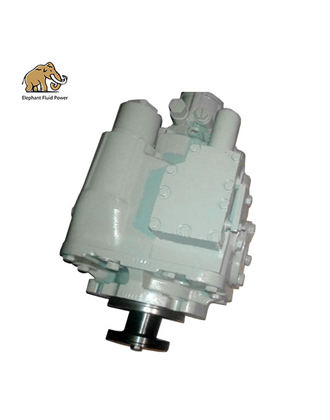
The A11VO is a high-pressure variable-displacement piston pump designed specifically for Bosch Rexroth’s open-loop systems in mobile machinery. It features a swashplate-type variable-displacement design with a rated continuous pressure of 350 bar and a short-term peak pressure of 400 bar. The suffix number indicates the nominal displacement, which is divided into two main categories: small-to-medium displacement (40–145) and large displacement (190, 260).
Detailed descriptions of each model
A11VO40
1. Basic Parameters: 42 cc/r, maximum 3000 r/min; offers the highest maximum speed and smallest size across the entire series;
2. Structural Features: Compact housing, small suction port size, excellent self-priming performance, no forced replenishment required; the through-shaft design allows for series connection with small gear pumps to serve as steering or pilot oil sources;
3. Common Controls: DRS, LR, EP (electro-proportional);
4. Typical Applications: Micro loaders, auxiliary pumps for truck-mounted cranes, small drilling rigs, hydraulic main pumps for sanitation vehicles, and pilot pumps for construction machinery.
5. Advantages and Disadvantages: Compact size, requiring minimal installation space; low output flow rate, suitable only for light-duty equipment; unable to drive heavy-duty actuators.
A11VO60
1. Basic Parameters: 58.5 cc/r, maximum 2700 r/min, Entry-level workhorse for small-to-medium flow rates;
2. Structural Features: Moderately sized housing, stable self-priming, simple piping layout; high expandability with through-shaft design;
3. Common Control: LRDS (Load-Sensitive + Constant Power), standard on small construction equipment;
4. Typical Applications: Small wheel loaders, 6-cubic-meter concrete mixer trucks, light-duty asphalt pavers, small rock drilling rigs.
5. Advantages and Disadvantages: High cost-effectiveness and low fuel consumption; insufficient flow rate for heavy-load operations; not suitable for large concrete equipment.
A11VO75
1. Basic Parameters: 74 cc/r, maximum 2550 r/min, flow rate between 60 and 95;
2. Design Features: Upgraded housing strength; enlarged internal plunger friction pairs for improved load-bearing capacity; self-priming with no risk of cavitation;
3. Common Control Systems: LRDS, HD pilot control;
4. Typical Applications: Light-duty milling machines, small mining loaders, road maintenance vehicles, small wet sprayers.
5. Advantages and Disadvantages: Balances speed and flow rate, suitable for medium loads; insufficient single-pump flow for high-power equipment, so two pumps are often used in series.
A11VO95
1. Basic Parameters: 93.5 cc/r, maximum 2350 r/min, classic displacement for medium-sized equipment;
2. Structural Features: Larger cylinder block and plunger dimensions provide better pressure stability and lower temperature rise during prolonged continuous operation;
3. Common Control Systems: LRDS; compatible with both paving and earthmoving machinery;
4. Typical Applications: Medium-duty wheel loaders, asphalt pavers, small concrete wet sprayers, and main pumps for road rollers.
5. Advantages and Disadvantages: Well-balanced overall performance, large installed base, and widely available spare parts; insufficient flow rate for large concrete pump trucks, so it is used only as an auxiliary pump.
A11VO130
1. Basic Specifications: 130 cc/r, maximum 2100 r/min; standard main pump for concrete machinery;
2. Structural Features: Enlarged suction chamber with excellent self-priming capability; the A11VLO oil-supplementation version is unnecessary for the vast majority of operating conditions; highly integrated valve block;
3. Common Control Systems: LRDS (constant power + load-sensing), industry standard; EP electronic control is used in smart concrete pump trucks;
4. Typical Applications: 37/43-meter concrete pump trucks, medium-sized wet spraying trucks, motor graders, and medium-sized mining drill rigs;
5. Advantages and Disadvantages: Flow, pressure, and power are perfectly matched to mainstream construction equipment, and spare parts are readily available; however, the single-pump flow rate is insufficient for extra-large concrete pump trucks, which require the 190/260 models.
A11VO145
1. Basic Parameters: 145 cc/r, maximum 2200 r/min; higher RPM than the 130/190 models in the same displacement class;
2. Structural Features: Optimized cylinder block design for reduced vibration during high-speed operation; stable self-priming capability, eliminating the need for an internal makeup pump;
3. Common Controls: LRDS, LRDU2 (displacement limiter adapted for low-horsepower engines);
4. Typical Applications: Large wheel loaders (5 metric tons and above), medium-sized road milling machines, and underground mining haulage vehicles;
5. Advantages and Disadvantages: Delivers higher flow rate than the 130 model at equivalent RPM, making it suitable for high-flow earthmoving equipment; rarely used in concrete pump trucks.
A11VO190
1. Basic Specifications: 193 cc/r, maximum 2100 r/min; designed specifically for high-flow, heavy-duty equipment;
2. Structural Features: The standard A11VO has weak self-priming capability and is highly prone to cavitation, screeching, and wear under high loads and high speeds; therefore, the A11VLO190 version with a makeup oil pump is uniformly selected for engineering applications; the housing is thickened, and internal friction pairs are reinforced;
3. Common Control Systems: LRDS and EPD1 electro-proportional electronic control;
4. Typical Applications: 48/56-meter large concrete pump trucks, heavy-duty mining roadheaders, and high-flow wet spraying rigs;
5. Advantages and Disadvantages: Single-pump flow rate is sufficient to drive large hydraulic cylinder motors; the version without a makeup pump has an extremely high failure rate and higher procurement costs.
A11VO260
1. Basic Parameters: 260 cc/r, maximum 2000 r/min, highest output flow rate in the entire series;
2. Structural Features: Cylinder block, plungers, and distribution plate are all enlarged and widened; the housing is thickened for pressure resistance; the standard A11VO260 model must not be installed independently; the A11VLO260 model with a built-in makeup pump must be selected to ensure forced oil supply and eliminate cavitation; the through-shaft design allows for series connection with large-capacity auxiliary pumps;
3. Common Control Methods: EPD1 electronic control, LRDS hydraulic control;
4. Typical Applications: Ultra-large concrete pump trucks with a reach of 60 meters or more, large-scale underground mining equipment, and high-flow tunnel boring equipment;
5. Advantages and Disadvantages: A single pump can meet the flow requirements of ultra-high-flow systems, eliminating the need for a dual-pump combined flow configuration; however, due to its large size, weight, and high cost, it is suitable only for heavy-duty equipment.
What is a charge pump A11VLO
What is the power setting of the A11VO
 French
 Portuguese
 Russian
 German
 Spanish
 Japanese
 Korean
 Irish
Irish
 Greek
Greek
 Turkish
 Italian
 Danish
 Romanian
 Indonesian
 Czech
Czech
 Afrikaans
 Swedish
 Polish
 Basque
 Catalan
 Esperanto
 Hindi
Hindi
 Lao
Lao
 Albanian
 Armenian
 Azerbaijani
 Belarusian
 Bengali
 Bosnian
 Bulgarian
 Cebuano
 Chichewa
 Croatian
 Dutch
Dutch
 Estonian
 Finnish
 Galician
 Georgian
 Haitian
 Hebrew
 Hmong
Hmong
 Hungarian
 Icelandic
 Javanese
 Kazakh
 Khmer
Khmer
 Latin
Latin
 Latvian
 Lithuanian
 Luxembourg
 Macedoniar
 Malagasy
 Malay
Malay
 Maltese
 Maori
Maori
 Mongolian
 Burmese
 Nepali
 Norwegian
 Pashto
 Persian
 Punjabi
 Serbian
 Sinhala
 Slovak
 Slovenian
 Somali
 Samoan
 Tajik
Tajik
 Thai
Thai
 Ukrainian
 Uzbek
Uzbek
 Vietnamese
 Welsh
Welsh
 Yiddish
 Yoruba