French
Portuguese
Russian
German
Spanish
Japanese
Korean
Irish
Greek
Turkish
Italian
Danish
Romanian
Indonesian
Czech
Afrikaans
Swedish
Polish
Basque
Catalan
Esperanto
Hindi
Lao
Albanian
Amharic
Armenian
Azerbaijani
Belarusian
Bengali
Bosnian
Bulgarian
Cebuano
Chichewa
Corsican
Croatian
Dutch
Estonian
Filipino
Finnish
Frisian
Galician
Georgian
Gujarati
Haitian
Hausa
Hawaiian
Hebrew
Hmong
Hungarian
Icelandic
Igbo
Javanese
Kannada
Kazakh
Khmer
Kurdish
Kyrgyz
Latin
Latvian
Lithuanian
Luxembourg
Macedoniar
Malagasy
Malay
Malayalam
Maltese
Maori
Marathi
Mongolian
Burmese
Nepali
Norwegian
Pashto
Persian
Punjabi
Serbian
Sesotho
Sinhala
Slovak
Slovenian
Somali
Samoan
Scots Gaelic
Shona
Sindhi
Sundanese
Swahili
Tajik
Tamil
Telugu
Thai
Ukrainian
Urdu
Uzbek
Vietnamese
Welsh
Xhosa
Yiddish
Yoruba
Zulu
First, Core Functions and Working Principle.
The excavator main pump is the core component of the hydraulic system, responsible for converting the mechanical energy of the engine into hydraulic energy to provide power for the actuators such as the moving arm, bucket lever, bucket and other actuators. Its working principle is based on axial piston pump technology, in which the cylinder is rotated by the drive shaft, so that the piston reciprocates in the cylinder bore to realize the oil suction and discharge process. Every time the main pump rotates, several plungers complete the oil suction and discharge in sequence, thus continuously outputting high-pressure oil.
Second, Main Types and Brands
1. Types:
Variable displacement piston pumps: the displacement can be adjusted according to the working demand, realizing the flow distribution according to the demand and improving the energy efficiency.
Fixed displacement pumps: fixed displacement, suitable for applications that require high flow stability.
2. Brands:
Kawasaki: such as K3V, K5V series, widely used in Sany, Sumitomo, Carter and other brands of excavators.
Rexroth: such as A11VO series, known for high performance and reliability.
Other brands: including Caterpillar, Komatsu, Hyundai and other private brand pumps.
Third, technical parameters and selection points
1. Key parameters:
Displacement: such as K3V112 displacement of 112ml / r, directly affect the output flow of the pump.
Rated pressure: such as 31.4MPa, determines the maximum working pressure the pump can withstand.
Maximum flow rate: such as 202L/min, reflecting the output capacity of the pump at rated speed.
Rotation speed range: need to match with the engine speed, to ensure that the pump runs efficiently.
2. Selection points:
tonnage matching: according to the tonnage of the excavator to choose the appropriate displacement of the main pump, such as 12-15 tons of models choose K3V63, 30 tons of models choose K3V180.
Working conditions adaptive: frequent heavy-duty working conditions preferred variable pumps, light-duty working conditions can be used to choose a quantitative pump.
Brand compatibility: Ensure that the main pump matches with the engine, hydraulic valves and other components to avoid power waste.
Fourth, common faults and maintenance
1. Common faults:
Engine overload: may be caused by the pump output flow is too large or the system pressure is too high.
Low pump output flow: may be caused by insufficient swashplate tilt, plunger wear or poor oil suction.
Vibration and noise: may be caused by loose parts in the pump, cavitation or oil contamination.
2. Maintenance Points:
Regularly check the oil level and quality: Make sure the oil is clean to avoid contamination that may cause pump wear.
Check the sealing: Check the pump body bonding surface, shaft seal and piping joints daily to prevent leakage.
Avoid prolonged inactivity: Start the pump for a short period of time during decommissioning, or manually rotate the shaft to prevent parts from seizing.
Standardize starting and stopping: make sure there is no load before starting, idle to eliminate air; reduce the load before stopping to avoid pressure shock.
Fifth, market trends and user evaluation
1.Technology trends:
Intelligent: integration of sensors and control systems to achieve early warning of failures and optimization of energy efficiency.
Green: electric hydraulic pumps are gradually popularized, reducing fuel consumption and exhaust emissions.
Modularization: modular design of the pump structure, easy maintenance and parts replacement.
2. User evaluation:
High efficiency: users generally reflect that the main pump moves fast and has stable quality, which significantly improves operational efficiency.
Durability: The key components are made of high-strength materials, and the life span is extended to more than 8,000 hours.
Cost-effectiveness: standardized maintenance can extend the life of the pump to 10,000 hours, saving more than 30,000 yuan in average annual maintenance costs.
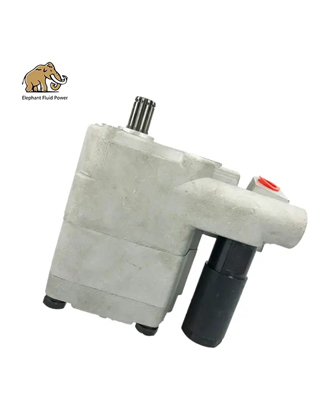
Main hydraulic pump diagram
Excavator hydraulic pump types