French
Portuguese
Russian
German
Spanish
Japanese
Korean
Irish
Greek
Turkish
Italian
Danish
Romanian
Indonesian
Czech
Afrikaans
Swedish
Polish
Basque
Catalan
Esperanto
Hindi
Lao
Albanian
Amharic
Armenian
Azerbaijani
Belarusian
Bengali
Bosnian
Bulgarian
Cebuano
Chichewa
Corsican
Croatian
Dutch
Estonian
Filipino
Finnish
Frisian
Galician
Georgian
Gujarati
Haitian
Hausa
Hawaiian
Hebrew
Hmong
Hungarian
Icelandic
Igbo
Javanese
Kannada
Kazakh
Khmer
Kurdish
Kyrgyz
Latin
Latvian
Lithuanian
Luxembourg
Macedoniar
Malagasy
Malay
Malayalam
Maltese
Maori
Marathi
Mongolian
Burmese
Nepali
Norwegian
Pashto
Persian
Punjabi
Serbian
Sesotho
Sinhala
Slovak
Slovenian
Somali
Samoan
Scots Gaelic
Shona
Sindhi
Sundanese
Swahili
Tajik
Tamil
Telugu
Thai
Ukrainian
Urdu
Uzbek
Vietnamese
Welsh
Xhosa
Yiddish
Yoruba
Zulu
Excavator main pump is the key component to convert mechanical energy into liquid pressure energy, common types are gear pumps and piston pumps, the main components and detailed structure of different types of main pumps have their own characteristics:
First, Gear Pumps
1.Main components: mainly consists of a pair of meshing gears, pump body, end cover and other components.
2. Detailed structure: the liquid volume of the gear pump is located between the two gears, through the rotation of the gear to change the liquid volume. When the engine drives one of the gears to rotate, the other gear rotates with meshing, forming the suction chamber on the gear disengagement side, and as the gears rotate, the oil is carried between the teeth to the discharge chamber.
3. Working principle
gear pump is mainly composed of a pair of meshing gears, pump body, end cover and other components. When the engine drives one of the gears to rotate, the other gear rotates with the meshing. In the gear disengagement side of the formation of the suction chamber, due to the teeth of the gears gradually out of mesh, so that the volume of the cavity gradually increased, forming a local vacuum, under the action of atmospheric pressure, the hydraulic oil in the tank will be sucked through the oil pipe into the suction chamber. As the gears continue to rotate, the inhaled hydraulic oil will be carried between the teeth to the discharge chamber, in the discharge chamber, the gears into the mesh state, so that the volume of the chamber is gradually reduced, the hydraulic oil is squeezed, the pressure rises, so that the hydraulic oil will be discharged from the pump body, delivered to the excavator's hydraulic system.
Second, piston pump
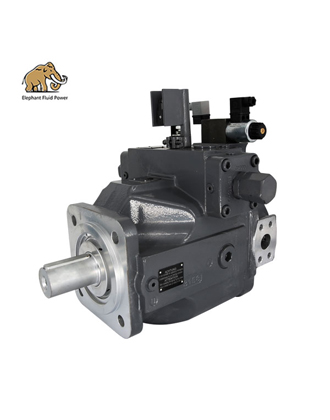
1. Main components: axial piston pump, for example, mainly by the cylinder, plunger, oil distribution plate, swash plate (or cam), etc.; large excavators use double pumps plus a pilot pump merge control form of the main pump (such as the Kawasaki hydraulic pump), roughly, the front pump, the pump body, the back pump, the pilot pump, regulator and other parts.
2. Detailed structure
Single plunger pump structure: multiple plungers evenly distributed on the circumference of the cylinder, the plunger can be reciprocating movement in the cylinder plunger hole. The action of swash plate (or cam) makes the plunger reciprocate when the cylinder rotates. There are oil suction window and oil pressure window on the distributor plate, which are used for oil suction and oil pressure process respectively. When the cylinder rotates, the plunger extends outward under the action of swash plate (or cam), so that the sealing volume in the plunger hole increases and the oil is sucked in through the suction window of the oil distribution plate; when the plunger retracts inward, the sealing volume decreases and the oil is discharged through the pressure window.
Multi-pump combination structure: In the structure of double pump plus pilot pump, two plunger pumps and a pilot gear pump are connected in series before and after. The front pump and rear pump respectively control the excavator left and right side of a walking, for the walking motor oil supply; big arm cylinder is a double pump combined flow, closing the arm and open the arm (bucket cylinder) is also a double pump combined flow, bucket and rotating by the front and rear pumps among a pump for oil supply. The pilot pump provides control pressure for the combination valve. Oil discharged from the main pump to the control valve (multi-way valve, distribution valve), through the control valve spool switching control, so that the pressure oil into the different cylinders of different chambers, pushing the cylinder piston movement, so as to realize the excavator action.
3.Working Principle
Single Plunger Pump
Take single plunger pump as an example, the cam is driven by the motor to rotate. When the cam pushes the plunger to move upward, the sealing volume formed by the plunger and the cylinder reduces, and the oil is squeezed out from the sealing volume and discharged to the place where it is needed through the check valve. When the cam rotates to the descending part of the curve, the spring forces the plunger downward, forming a certain vacuum, and the oil in the tank enters the sealing volume under the action of atmospheric pressure. The cam causes the plunger to rise and fall continuously, and the sealing volume periodically decreases and increases, so the pump continuously sucks in and discharges oil.
Axial Piston Pumps
Axial piston pumps are mainly composed of cylinder, piston, oil distribution disk, swash plate (or cam) and so on. Multiple plungers are evenly distributed on the circumference of the cylinder, and can reciprocate in the plunger hole of the cylinder. When the cylinder rotates, the plunger extends outward under the action of the swash plate (or cam), so that the sealing volume in the plunger hole increases, and the oil is sucked through the oil suction window of the oil distribution plate; when the plunger retracts inward, the sealing volume decreases, and the oil is discharged through the oil compression window, thus realizing the process of sucking and compressing oil.
Main hydraulic pump diagram
Excavator hydraulic pump types