French
Portuguese
Russian
German
Spanish
Japanese
Korean
Irish
Greek
Turkish
Italian
Danish
Romanian
Indonesian
Czech
Afrikaans
Swedish
Polish
Basque
Catalan
Esperanto
Hindi
Lao
Albanian
Amharic
Armenian
Azerbaijani
Belarusian
Bengali
Bosnian
Bulgarian
Cebuano
Chichewa
Corsican
Croatian
Dutch
Estonian
Filipino
Finnish
Frisian
Galician
Georgian
Gujarati
Haitian
Hausa
Hawaiian
Hebrew
Hmong
Hungarian
Icelandic
Igbo
Javanese
Kannada
Kazakh
Khmer
Kurdish
Kyrgyz
Latin
Latvian
Lithuanian
Luxembourg
Macedoniar
Malagasy
Malay
Malayalam
Maltese
Maori
Marathi
Mongolian
Burmese
Nepali
Norwegian
Pashto
Persian
Punjabi
Serbian
Sesotho
Sinhala
Slovak
Slovenian
Somali
Samoan
Scots Gaelic
Shona
Sindhi
Sundanese
Swahili
Tajik
Tamil
Telugu
Thai
Ukrainian
Urdu
Uzbek
Vietnamese
Welsh
Xhosa
Yiddish
Yoruba
Zulu
An Excavator pump usually refers to a pump on an excavator that is used for fuel injection or hydraulic systems. These pumps are essential for the proper functioning of the excavator, they provide the necessary power and control.
Specifically, excavator pumps can be divided into many types, such as fuel injection pumps and hydraulic pumps, etc. The fuel injection pump is responsible for injecting fuel into the engine at high pressure to ensure the normal operation of the engine. The hydraulic pump is the heart of the hydraulic system, which converts mechanical energy into hydraulic energy to provide power for various actions of the excavator.
In excavators, hydraulic pumps usually have the characteristics of high pressure and large flow to meet the needs of excavators in complex working conditions. At the same time, these pumps also need to have good wear resistance and reliability to ensure the long-term stable operation of the excavator.
First, type
Gear pump: simple structure, reliable work, low cost, can adapt to harsh working conditions. However, the flow and pressure fluctuate greatly and the noise is high, so it is mainly used for small excavators or systems that do not require high flow and pressure stability.
Vane pump: uniform flow, stable operation, low noise and high volumetric efficiency. However, it is sensitive to oil pollution and has relatively low working pressure, so it is often used in the hydraulic system of medium and low pressure excavators.
Piston pump: high efficiency, large flow, high pressure, convenient variables, can meet various complex actions and load requirements of excavators, and is widely used in modern excavators.
Second, how it works
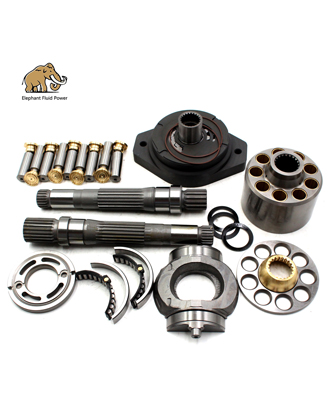
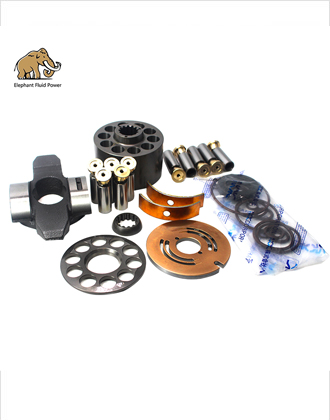
Taking the piston pump as an example, it is mainly composed of a stator, a plunger, a plunger sleeve, a swash plate, etc. The plunger does reciprocating motion in the pump cylinder under the action of the swash plate to change the working volume. When the plunger leaves the stator surface, the working volume increases to form negative pressure, and the hydraulic oil is sucked in through the suction port; When the plunger moves towards the stator, the working volume decreases, the hydraulic oil pressure increases, and it is discharged through the oil drain port and enters the hydraulic system to provide power to the actuator. By changing the angle between the swash plate and the plunger, the length of the plunger stroke can be controlled to adjust the pump flow rate.
Third, role
Energy conversion: The mechanical energy output by the engine is converted into the hydraulic energy of the hydraulic oil to provide power for the various working parts of the excavator, such as the boom, the small arm, the bucket, the walking mechanism, the slewing mechanism, etc., so that it can complete the excavation, lifting, slewing, walking and other actions.
Flow and pressure control: According to the working needs of the excavator, the flow and pressure of the hydraulic oil are precisely controlled to achieve the speed and force adjustment of different actions.
Fourth, Maintenance & Maintenance
Replace hydraulic oil regularly: to prevent oil pollution and deterioration from causing wear, corrosion and other damage to the excavator pump, generally replace it every 2000-3000 hours or half a year to a year.
Keep the oil clean: When refueling and changing the oil, make sure that the oil is clean to prevent impurities from entering the system, and regularly clean or replace the hydraulic oil filter.
Check the seals: check the seals of the pump regularly, and replace them in time if there is any leakage to prevent the pressure drop and system performance reduction caused by oil leakage.
Best hydraulic pump for excavators
Excavator hydraulic pump types
Excavator hydraulic pumps