French
Portuguese
Russian
German
Spanish
Japanese
Korean
Irish
Greek
Turkish
Italian
Danish
Romanian
Indonesian
Czech
Afrikaans
Swedish
Polish
Basque
Catalan
Esperanto
Hindi
Lao
Albanian
Amharic
Armenian
Azerbaijani
Belarusian
Bengali
Bosnian
Bulgarian
Cebuano
Chichewa
Corsican
Croatian
Dutch
Estonian
Filipino
Finnish
Frisian
Galician
Georgian
Gujarati
Haitian
Hausa
Hawaiian
Hebrew
Hmong
Hungarian
Icelandic
Igbo
Javanese
Kannada
Kazakh
Khmer
Kurdish
Kyrgyz
Latin
Latvian
Lithuanian
Luxembourg
Macedoniar
Malagasy
Malay
Malayalam
Maltese
Maori
Marathi
Mongolian
Burmese
Nepali
Norwegian
Pashto
Persian
Punjabi
Serbian
Sesotho
Sinhala
Slovak
Slovenian
Somali
Samoan
Scots Gaelic
Shona
Sindhi
Sundanese
Swahili
Tajik
Tamil
Telugu
Thai
Ukrainian
Urdu
Uzbek
Vietnamese
Welsh
Xhosa
Yiddish
Yoruba
Zulu
As the power element of a hydraulic system, the core components of a hydraulic pump work together to realize the conversion of mechanical energy into hydraulic energy. The following is a detailed description of the key parts of a hydraulic pump:
First, Core Structural Components
1. Pump Body
Function: Serves as the support structure of the hydraulic pump, holding the working elements and forming the sealing volume.
Characteristics: need to have high strength and corrosion resistance, usually made of aluminum alloy or cast iron.
2. Drive Shaft
Function: Connects to the prime mover (e.g. motor or engine) and transmits rotational power to the working elements.
Design requirements: need to withstand torque and axial force, avoid radial loads to prevent bias wear.
3. working element
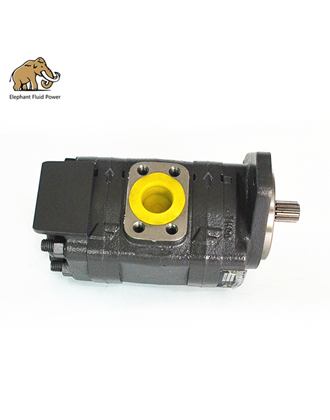
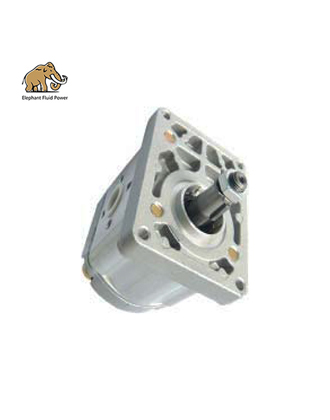
Gear pump: through the rotation of two meshing gears to form a sealed volume change, to realize the oil suction and discharge.
Advantages: simple structure, low cost, self-priming ability.
Disadvantages: flow pulsation, high noise, low efficiency.
Vane pump: rely on the rotor vane sliding in the stator curve, change the sealing volume.
Classification: double-acting vane pump (flow uniformity) and single-acting vane pump (variable).
Advantages: smooth operation, low noise, high volumetric efficiency.
Disadvantages: sensitive to oil contamination, poor oil suction capacity.
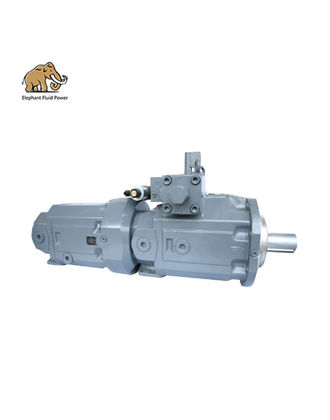
Piston pump: through the inclined disk or inclined shaft drive piston reciprocating motion, realize high pressure output.
Advantages: high pressure, high efficiency, long life.
Disadvantages: complex structure, high cost, strict requirements for oil cleanliness.
Screw pumps: the use of twin-screw meshing and rotating transfer of liquid, the formation of a continuous sealed volume.
Advantages: stable flow, low noise, good suction performance.
Disadvantages: high manufacturing precision, low power density.
Second, auxiliary function parts of hydraulic pump.
1. Inlet and outlet
Function: Connect the hydraulic pipeline to realize the suction and discharge of oil.
Design requirements: to avoid leakage, usually using seals or threaded connections.
2. sealing device
Type: including shaft seal, end seal, etc., to prevent oil leakage and external pollutants from entering.
Material: commonly used rubber, PTFE and other oil-resistant materials.
3. Variable control mechanism (for variable pump)
Function: Adjust the displacement of the pump to meet the needs of different working conditions.
Control mode:
Hydraulic control: adjust the swashplate angle by pressure signal.
Electric control: Utilizing proportional solenoid to realize precise displacement adjustment.
Manual control: Adjustment of displacement by mechanical lever.
4. Through-shaft drive structure (some pump models)
Function: Allows the installation of a gear pump or a second axial piston pump on the drive shaft of the pump, realizing multi-pump integration.
Application Scenario: Construction machinery requiring complex hydraulic systems.
Third, Key Design Elements
1. Seal Volume Change
Principle: The movement of the working element causes the seal volume to change periodically, realizing oil suction and discharge.
Requirements: the volume change should be continuous and no leakage to ensure efficiency.
2. Self-priming ability
Definition: The ability of the pump to suck oil from the tank without external assistance.
Influencing factors: pump speed, oil viscosity, suction piping design.
3. Efficiency and life
Volumetric efficiency: the ratio of actual output flow to theoretical flow, reflecting leakage.
Total efficiency: the ratio of output power to input power, reflecting the performance of the pump.
Life: depends on the material, manufacturing precision and use of maintenance.
Fourth, typical faults and maintenance
1. Common faults
No output: broken drive shaft, reverse electrical wiring, oil viscosity mismatch.
Loud noise: clogged suction pipe, clogged filter element, worn valve spool.
Insufficient flow: internal leakage, high oil temperature, abnormal oil viscosity.
2. Maintenance recommendations
Periodic inspection: oil cleanliness, worn seals, loose connection keys.
Replacement of parts: worn spool, aged seals, unsuitable hydraulic oil.
Adjust parameters: mating clearance, variable mechanism, system pressure.
Hydraulic pump parts list
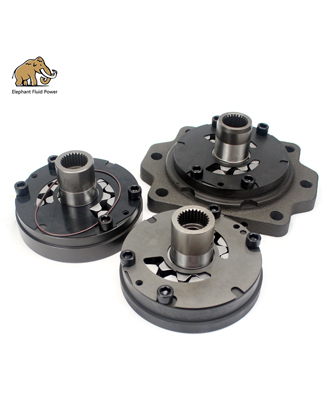
Hydraulic pump replacement parts
Mechanical hydraulic pump parts