French
Portuguese
Russian
German
Spanish
Japanese
Korean
Irish
Greek
Turkish
Italian
Danish
Romanian
Indonesian
Czech
Afrikaans
Swedish
Polish
Basque
Catalan
Esperanto
Hindi
Lao
Albanian
Amharic
Armenian
Azerbaijani
Belarusian
Bengali
Bosnian
Bulgarian
Cebuano
Chichewa
Corsican
Croatian
Dutch
Estonian
Filipino
Finnish
Frisian
Galician
Georgian
Gujarati
Haitian
Hausa
Hawaiian
Hebrew
Hmong
Hungarian
Icelandic
Igbo
Javanese
Kannada
Kazakh
Khmer
Kurdish
Kyrgyz
Latin
Latvian
Lithuanian
Luxembourg
Macedoniar
Malagasy
Malay
Malayalam
Maltese
Maori
Marathi
Mongolian
Burmese
Nepali
Norwegian
Pashto
Persian
Punjabi
Serbian
Sesotho
Sinhala
Slovak
Slovenian
Somali
Samoan
Scots Gaelic
Shona
Sindhi
Sundanese
Swahili
Tajik
Tamil
Telugu
Thai
Ukrainian
Urdu
Uzbek
Vietnamese
Welsh
Xhosa
Yiddish
Yoruba
Zulu
There are typically three types of hydraulic pump constructions found in mobile hydraulic applications.
The hydraulic pump is the component of the hydraulic system that takes mechanical energy and converts it into fluid energy in the form of oil flow. This mechanical energy is taken from what is called the prime mover (a turning force) such as the power take-off or directly from the truck engine.
With each hydraulic pump, the pump will be of either a uni-rotational or bi-rotational design. As its name implies, a uni-rotational pump is designed to operate in one direction of shaft rotation. On the other hand, a bi-rotational pump has the ability to operate in either direction.
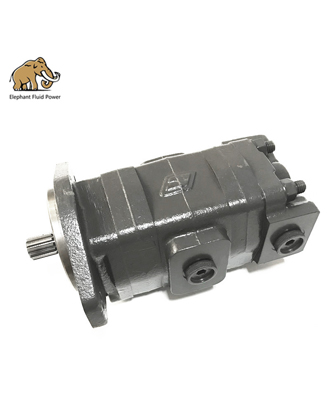
For truck-mounted hydraulic systems, the most common design in use is the gear pump. This design is characterized as having fewer moving parts, being easy to service, more tolerant of contamination than other designs and relatively inexpensive. Gear pumps are fixed displacement, also called positive displacement, pumps. This means the same volume of flow is produced with each rotation of the pump's shaft. Gear pumps are rated in terms of the pump's maximum pressure rating, cubic inch displacement and maximum input speed limitation.
Generally, gear pumps are used in open center hydraulic systems. Gear pumps trap oil in the areas between the teeth of the pump's two gears and the body of the pump, transport it around the circumference of the gear cavity and then force it through the outlet port as the gears mesh. Behind the brass alloy thrust plates, or wear plates, a small amount of pressurized oil pushes the plates tightly against the gear ends to improve pump efficiency.
QUICK LOOK
Most common design
Fewer moving parts, easy to service, more tolerant of contaminates, relatively inexpensive
Fixed, also called positive, displacement pumps
Rated in terms of max pressure rating, cubic inch displacement, max input speed limitation
Used in open center hydraulic systems
Transports oil around circumference of gear cavity and forces it through outlet port
Encompasses thrust plates that push against gear ends with small amount of pressurized oil to improve pump efficiency
PISTON PUMPS
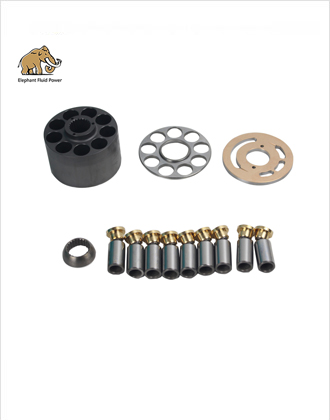
When high operating pressures are required, piston pumps are often used. Piston pumps will traditionally withstand higher pressures than gear pumps with comparable displacements; however, there is a higher initial cost associated with piston pumps as well as a lower resistance to contamination and increased complexity. This complexity falls to the equipment designer and service technician to understand in order to ensure the piston pump is working correctly with its additional moving parts, stricter filtration requirements and closer tolerances. Piston pumps are often used with truck-mounted cranes, but are also found within other applications such as snow and ice control where it may be desirable to vary system flow without varying engine speed.
A cylinder block containing pistons that move in and out is housed within a piston pump. It's the movement of these pistons that draw oil from the supply port and then force it through the outlet. The angle of the swash plate, which the slipper end of the piston rides against, determines the length of the piston's stroke. While the swash plate remains stationary, the cylinder block, encompassing the pistons, rotates with the pump's input shaft. The pump displacement is then determined by the total volume of the pump's cylinders. Fixed and variable displacement designs are both available.
QUICK LOOK
Withstand higher pressures
Higher initial cost, lower resistance to contamination and increased complexity
Additional moving parts, stricter filtration requirements and closer tolerances
Truck-mounted cranes
Good when desirable to vary system flow without varying engine speed
Fixed and variable displacement designs available
Encompasses cylinder block containing pistons that move in and out – this movement draws oil from the supply port and forces through the outlet
Angle of swash plate determines the length of the piston's stroke
Swash plate remains stationary
Displacement determined by total volume of pump cylinders
VANE PUMPS
Vane pumps were, at one time, commonly used on utility vehicles such as aerial buckets and ladders. Today, the vane pump is not commonly found on these mobile (truck-mounted) hydraulic systems as gear pumps are more widely accepted and available.
Within a vane pump, as the input shaft rotates it causes oil to be picked up between the vanes of the pump which is then transported to the pump's outlet side. This is similar to how gear pumps work, but there is one set of vanes – versus a pair of gears – on a rotating cartridge in the pump housing. As the area between the vanes decreases on the outlet side and increases on the inlet side of the pump, oil is drawn in through the supply port and expelled through the outlet as the vane cartridge rotates due to the change in area.
QUICK LOOK
Used on utility vehicles, but not as common today with gear pumps more widely accepted and available Input shaft rotates, causing oil to be picked up between the vanes of the pump which is then transported to pump outlet side as area between vanes decreases on outlet side and increases on inlet side to draw oil through supply port and expel though outlet as vane cartridge rotates.
Elephant Fluid Power have do hydraulic service for many years, and concentrate on hydraulic and heavy machine repair and maintain, OEM part supply, fast delivery time, best price, If have any question for your machine and parts, pls contact us, we will solve for you.