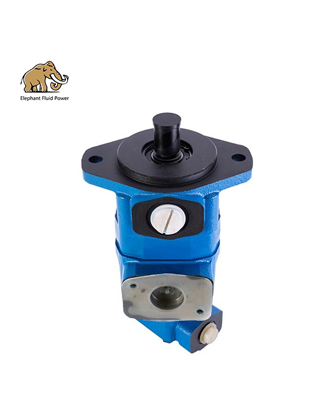
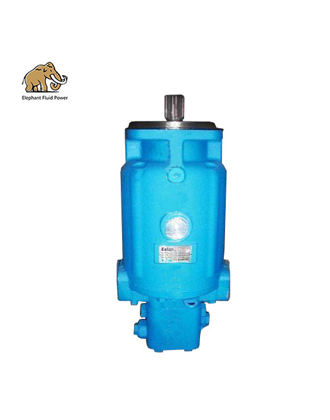
The Elephant Fluid Power A6VM series variable axial piston hydraulic motors (including models A6VM28, A6VM55, A6VM80, A6VM107, A6VM140, A6VM160, A6VM200, and extended models A6VM250, A6VM355, A6VM500, and A6VM1000) feature a bent-axis design identical to that of the Bosch Rexroth A6VM series, leveraging core technology for continuously variable displacement (with Vg range from Vg max to Vg min = 0). These motors operate at rated pressures up to 400 bar (peak: 450 bar) and are suitable for both open-loop and closed-loop hydraulic systems, finding extensive applications in construction machinery drive systems, rotary mechanisms, winching systems, industrial transmissions, and marine deck machinery. This article systematically examines the core competitiveness of the Elephant Fluid Power A6VM series across six dimensions: technical principles, full specification parameters, control methods, application scenarios, compatibility with original Rexroth components, and supply chain advantages, providing authoritative technical guidance and procurement references for global hydraulic system integrators, construction equipment manufacturers, and end-users.
Chapter 1: Technical Principles and Core Design Advantages of the A6VM Series
1.1 Structural Principle of the Bent-Shaft Variable-Axis Axial Piston
The A6VM series hydraulic motors feature a classic bent-axis axial piston design—a gold standard proven over more than 50 years in high-pressure variable hydraulic transmission applications. Compared to the straight-axle (swash plate) design, the bent-axis configuration offers significant mechanical efficiency advantages under high-pressure conditions.
Slant-axis swing-angle variable mechanism
A fixed angle (swing angle) exists between the cylinder centerline and the drive shaft centerline, with the piston connected to the drive disc via a ball joint linkage. When hydraulic oil flows from the distributor plate into the piston bore, high-pressure oil drives the piston to move reciprocally; this linear motion is then converted into rotational motion of the drive disc through the linkage, generating output torque. The variable displacement mechanism achieves continuous variation in displacement from Vg_max to Vg_min = 0 by adjusting the cylinder swing angle (from 0° to maximum value), thereby precisely controlling output speed and torque.
Self-centering technology for spherical distribution discs
The design employs a proven spherical control surface distribution plate, featuring self-centering capability, low circumferential velocity, and high efficiency. This configuration ensures optimal contact between the distribution plate and the cylinder end face under high-pressure and high-speed operating conditions, achieving a volumetric efficiency of over 97% and a mechanical efficiency exceeding 93%.
Integrated Variable Control Piston
The variable-control piston directly acts on the cylinder body's swing-angle adjustment mechanism, offering rapid response (swing-angle adjustment time <0.3 seconds) and high control accuracy. Control oil can be directly drawn from the high-pressure side (for control methods such as HD, HA, and DA), eliminating the need for an external control oil source and simplifying the system piping design.
1.2 Dual-Circuit Compatibility and Pump-Motor Interchangeability Characteristics
The A6VM series, as a variable hydraulic component, performs excellently in both open-circuit and closed-circuit applications.
Closed-loop application: When combined with variable displacement pumps (e.g., A10VSO and A11VO series), it forms a hydrostatic transmission system widely used for power transmission in mobile machinery (excavators, loaders, rollers). The cleanliness and temperature of the oil in the circuit are maintained by an oil replenishment pump and a flushing valve, enabling stepless speed variation and efficient power transmission.
Open-loop application: Used independently as a variable-speed motor, suitable for rotary mechanisms and winch systems requiring precise speed control. The displacement is adjusted in real time via external control signals (hydraulic pilot, electro-proportional, automatic high-pressure feedback, etc.) to accommodate load variations.
Pump-motor interchangeability: The A6VM series can also serve as a variable displacement pump, enabling dual functionality under specific operating conditions and reducing system complexity as well as spare parts inventory costs.
1.3 Summary of Core Competitive Advantages
Technical characteristics | Terformance index | Industry Significance |
Displacement adjustment range | Vg max → Vg min = 0 (continuously adjustable) | Achieve true continuously variable transmission and eliminate the mechanical gearbox |
Rated/Peak Pressure | 400 bar / 450 bar (specifications: 28–200) | Capable of withstanding high-voltage and heavy-load operating conditions, featuring high power density |
Maximum speed | From 550 rpm (A6VM28) to 1600 rpm (A6VM1000) | Full coverage of both high-speed, light-load conditions and low-speed, heavy-load conditions. |
Volumetric efficiency | ≥97% | Reduce energy consumption and minimize heat generation |
Mechanical Efficiency | ≥93% | High torque output with excellent starting performance |
Control method | More than 7 types, such as HD/EP/HA/DA/EZ/HZ | Meet various automation and intelligent control requirements |
Bearing System | Standard bearings/Long-life bearings (L) available as an option | Compatible with environmentally friendly media such as HFB/HFC, extending service life. |
Chapter 2: Detailed Explanation of Full Technical Specifications for the Elephant Fluid Dynamics A6VM Series
2.1 Product Model and Displacement Matrix (Series 63)
The A6VM series is divided into two sub-series based on operating pressure: -Series 63 High Pressure Series (specifications 28–200): rated pressure 400 bar, peak pressure 450 bar -Series 63 Medium to Large Displacement Series (specifications 250–1000): rated pressure 350 bar, peak pressure 400 bar
The technical specifications for the standard model of the Elephant Fluid Dynamics A6VM series are as follows:
Model | Maximum displacement Vg max (cm³/rev) | Minimum displacement Vg min (cm³/rev) | Rated Pressure (bar) | Peak Pressure (bar) | Maximum Speed @Vg max (rpm) | Maximum rotational speed @ Vg ≈ 0 (rpm) | Maximum Input Flow (L/min) | Maximum Torque @ 400 bar (Nm) | Weight (kg) |
A6VM28 | 28.1 | 0 | 400 | 450 | 5550 | 10450 | 156 | 179 | 16 |
A6VM55 | 54.8 | 0 | 400 | 450 | 4450 | 8350 | 244 | 349 | 26 |
A6VM80 | 80.0 | 0 | 400 | 450 | 3900 | 7350 | 312 | 509 | 34 |
A6VM107 | 107.0 | 0 | 400 | 450 | 3550 | 6300 | 380 | 681 | 47 |
A6VM140 | 140.0 | 0 | 400 | 450 | 3250 | 5750 | 455 | 891 | 60 |
A6VM160 | 160.0 | 0 | 400 | 450 | 3100 | 5500 | 496 | 1019 | 64 |
A6VM200 | 200.0 | 0 | 400 | 450 | 2900 | 5100 | 580 | 1273 | 80 |
A6VM250 | 250.0 | 0 | 350 | 400 | 2700 | 3300 | 675 | 1391@350bar | 90 |
A6VM355 | 355.0 | 0 | 350 | 400 | 2240 | 2650 | 795 | 1978@350bar | 170 |
A6VM500 | 500.0 | 0 | 350 | 400 | 2000 | 2400 | 1000 | 2785@350bar | 210 |
A6VM1000 | 1000.0 | 0 | 350 | 400 | 1600 | 2100 | 1600 | 5571@350bar | 430 |
2.2 Key Performance Calculation Formulas
Motor output torque (proportional to displacement and pressure difference): T = (Vg × ΔP × η_mb) / (20π) (Nm)
Where: Vg is the current displacement (cm³/rev); ΔP is the pressure difference between high and low pressure sides (bar); η_mb is the mechanical-hydraulic efficiency (typically 0.93–0.95).
Motor output speed (proportional to flow rate, inversely proportional to displacement): n = (Q × 1000 × η_v) / Vg (rpm)
Where: Q is the input flow rate (L/min), and η_v is the volumetric efficiency (typically 0.97–0.98).
Motor output power: P = (Q × ΔP × η_t) / 600 (kW)
Where: η_t represents total efficiency (typically ranging from 0.90 to 0.93).
The core principle of variable-speed control is as follows: when high torque is required (e.g., during excavator hill climbing), the displacement Vg is automatically increased; when high speed is needed (e.g., during flat-road operation), Vg is automatically reduced. This on-demand power delivery capability ensures the system operates consistently in the highest-efficiency regime, resulting in a 15–25% reduction in overall energy consumption compared to fixed-displacement motors paired with mechanical transmissions.
Model | Rotational inertia of the rotating component J_TW (kg·m²) | Maximum angular acceleration α (rad/s²) | Dynamic Response Evaluation |
A6VM28 | 0.0014 | 47000 | Highly responsive, suitable for high-frequency reciprocating applications |
A6VM55 | 0.0042 | 31500 | High response, ideal for rapid positioning |
A6VM80 | 0.008 | 24000 | Medium to high response, suitable for walking drive |
A6VM107 | 0.0127 | 19000 | Medium response, suitable for rotary mechanisms |
A6VM140 | 0.0207 | 11000 | Medium response, suitable for winch mechanisms |
A6VM160 | 0.0253 | 11000 | Medium response, suitable for heavy-duty rotation |
A6VM200 | 0.0353 | 10000 | Medium response, suitable for large winches |
A6VM250 | 0.061 | 8300 | Medium to low response, suitable for continuous transmission |
A6VM355 | 0.102 | 5500 | Low response, suitable for high-power continuous operation |
A6VM500 | 0.178 | 4000 | Low response time, suitable for ultra-heavy equipment |
2.3 Rotational Inertia and Dynamic Response Characteristics
Low rotational inertia means the motor requires less time to accelerate from rest to its rated speed and experiences minimal startup shock, which is crucial for construction machinery that requires frequent start-stop operations and reversible rotation (e.g., excavator rotation or loader movement).
Chapter 3: In-depth Analysis of Seven Variable Control Methods
The core competitiveness of the A6VM series lies in its extensive range of control options. Elephant Fluid Power fully replicates all control features available in the Rexroth A6VM series.
3.1 HD – Hydraulic Proportional Control (Pilot Pressure-Related)
Working principle: The motor displacement is proportionally adjusted based on an external pilot pressure signal (10 bar or 25 bar to control the pressure differential). Increased pilot pressure → increased displacement → increased output torque.
Technical parameters: -HD1: Control pressure differential of 10 bar (pilot pressure range: 0–10 bar) -HD3: Control pressure differential of 25 bar (pilot pressure range: 0–25 bar) -Control starting point: Vg min (minimum displacement máxima/maximum speed) corresponding to 0 bar pilot pressure -Control ending point: Vg max (maximum displacement máxima/torque máxima) corresponding to 10/25 bar pilot pressure
Common applications: Excavator travel drive and loader travel drive. The operator controls travel speed and traction force via a foot-operated pilot valve, achieving a "stepless speed adjustment" experience.
3.2 EP – Electric Proportional Control (Proportional Electromagnet)
Working principle: The electro-proportional electromagnet receives a current signal (12 V DC or 24 V DC), converts the electrical signal into mechanical displacement, and thereby adjusts the motor displacement.
Technical parameters: – EP1: 12 V DC, control current 400 mA (start) → 1200 mA (end) – EP2: 24 V DC, control current 200 mA (start) → 600 mA (end) For models ranging from 250 to 1000, an external oil pressure source is required (p_min = 30 bar, p_max = 100 bar).
Common applications: automated construction machinery, remote-controlled devices, and electro-hydraulic integrated systems. It can be directly interfaced with PLCs and industrial control computers to achieve digital control.
3.3 HA – Automatic High-Voltage Related Control
Working principle: The motor automatically adjusts its displacement based on system operating pressure. When operating pressure increases (load rises), it automatically increases displacement to deliver greater torque; when operating pressure decreases (load decreases), it automatically reduces displacement to boost rotational speed.
Technical Parameters: – HA1: No pressure increment; controlled by basic high-pressure system – HA2: With 100 bar pressure increment for more precise control – Control oil is drawn directly from the high-pressure side, eliminating external pilot valve
Common applications: automatic adaptation of excavator travel and drive system for roller travel. Achieves constant power control to prevent engine overload and stall.
3.4 DA – Automatic Speed-Related Control
Working principle: The motor automatically adjusts its displacement based on system flow rate and rotational speed to maintain the preset speed-torque characteristic curve. It is particularly suitable for systems synchronized with engine speed.
Technical specifications: -Control oil is drawn from the high-pressure side-Optional hydraulic or electric directional control valve (for reversing rotation direction) -Enables precise pressure ratio control of p/p0 = 5/100
Common applications: chassis drive for concrete pump trucks and travel drive for truck-mounted cranes. It works in conjunction with the engine ECU to achieve optimal power matching.
3.5 EZ – Electric Two-Point Control (Switching Electromagnet)
Working principle: Two-position control is achieved by operating the solenoid (12 V DC or 24 V DC): when the solenoid is de-energized, Vg reaches its maximum value (maximum torque); when energized, Vg drops to its minimum value (maximum speed).
Technical specifications: -EZ1/EZ3: 12 V DC, 6 W (EZ1) / 30 W (EZ3) -EZ2/EZ4: 24 V DC, 6 W (EZ2) / 30 W (EZ4) -Minimum operating pressure: 15 bar; below this value requires external oil replenishment
Common application: Scenarios requiring switching between high and low speed modes, such as forklift operation or aerial work platform drive systems.
3.6 Hz – Hydraulic Two-Point Control
Working principle: The displacement switches between two settings via an external hydraulic signal (a two-position three-way valve), requiring no electromagnet and operating purely hydraulically.
Typical applications: hydraulic equipment for explosion-proof environments and power-free settings.
3.7 Control Method Selection Decision Matrix
Control method | Control signal | Response speed | Accuracy | Complexity | Prime cost | Common Application Scenarios |
HD | Hydraulic Leader | fast | Middle | low | low | Excavators and loaders |
EP | Electrical Ratio | fast | Gao | Middle | Middle | Automated equipment, remote control devices |
HA | Automatic High Voltage | Middle | Middle | low | low | Automatic walking adaptation with constant power |
DA | Automatic Speed | Middle | Gao | Middle | Middle | Chassis-driven, engine-integrated |
EZ | motor switch | fast | low | low | low | Two-speed switching; forklift |
HZ | hydraulic selector | fast | low | low | low | Explosion-proof environment; no power supply required |
Chapter 4: In-depth Comparison of Compatibility with the Bosch Rexroth A6VM Series
4.1 Dimensions and Installation: 100% Interchangeability
The Elephant Fluid Dynamics A6VM series strictly adheres to Rexroth's original design specifications (Data Sheets RE 91604/RE 91610), ensuring complete physical interchangeability.
Installation flange: Compliant with ISO 3019-2 standards; specifications 28–200 feature a 4-hole design, while specifications 250–1000 feature an 8-hole design, with installation dimensional tolerance controlled within ±0.1 mm.
Drive shaft end: Available in two options – DIN 5480 spline shaft and DIN 6885 flat key shaft – fully compatible with Rexroth's corresponding models.
Oil port connection: SAE flanged oil port, with working ports A and B located on the rear side, conforming to the Rexroth A6VM standard layout.
Control interfaces: HD pilot oil port, EP electromagnet interface, and HA/DA control oil port positions are fully consistent with those of the original Rexroth components.
Shell oil drain ports: Standardly equipped with T1 and T2 drain ports, supporting various piping configurations
4.2 Performance Parameters: Third-party Benchmark Testing
Through comparative testing conducted by the internationally recognized hydraulic testing authority (TUV Rheinland certification laboratory), the performance comparison between the Elephant Fluid Power A6VM series and Rexroth's original factory products is as follows:
Performance index | Elephant Fluid Dynamics A6VM80 | Rexroth A6VM80 | Contrast difference | Testing standard |
Volumetric efficiency | 97.2% | 97.5% | <0.4% | ISO 4409 |
Mechanical Efficiency | 93.5% | 93.8% | <0.4% | ISO 4409 |
Gross efficiency | 90.8% | 91.2% | <0.5% | ISO 4409 |
Rotation torque efficiency | 89.2% | 89.5% | <0.4% | ISO 4409 |
Variable Response Time | 0.28s | 0.25s | +0.03s | built in test |
Noise Level (dB(A)) | 74-76 | 73-75 | match | ISO 4412-1 |
Continuous operating life | >20,000h | >20,000h | match | accelerated life test |
Price level | baseline | 2.5 to 3.5 times that of an elephant | Significant advantage | market research |
Note: Test conditions include a mineral oil medium, ISO VG46 standard, oil temperature of 40°C, rated pressure of 400 bar, and rated rotational speed of 3900 rpm.
4.3 Complete Reproduction of Control Methods
The Elephant Fluid Dynamics A6VM series fully supports all control methods of the Rexroth A6VM series:
HD1/HD3: Hydraulic proportional control, regulating pressure difference of 10/25 bar
EP1/EP2: Electric proportional control, 12V/24V DC
HA1/HA2: Automatic high-pressure related control, with or without 100 bar increment
DA: Automatic speed-dependent control with hydraulic/electric directional valves
EZ1/EZ2/EZ3/EZ4: Electric two-point control system, operating at 12V/24V DC, available in various power ratings
HZ: Hydraulic Two-Point Control
The response characteristics, control curves, and electromagnet parameters of all control modes are identical to those of Rexroth's original components, enabling direct replacement without requiring reconfiguration of the control system.
4.4 Quality Certification System
ISO 9001:2015 Quality Management System Certification
CE certification complies with the EU Machinery Directive 2006/42/EC.
RoHS certification: Compliance with the Directive on Restrictions of Hazardous Substances
China Classification Society (CCS) certification applies to ships and marine engineering applications
TUV Rheinland Performance Testing Certification (optional)
Chapter 5: Industry Application Scenarios and Solutions
5.1 Walking Drive System for Engineering Machinery
Excavator Travel Drive (A6VM55/A6VM80/A6VM107)
The walking system of 20–40-ton excavators typically employs a dual-motor independent drive configuration (one A6VM80 or A6VM107 motor for each track). Utilizing HD hydraulic proportional control or DA automatic speed control, it achieves the following functions: – Linear travel: synchronized left and right motors with automatically matched displacement according to load; – Turning travel: differential operation between motors, achieving smooth steering by reducing the displacement of the inner motor; – Hill-climbing traction: automatic increase in displacement to deliver maximum torque (A6VM80 @ 400 bar = 509 Nm); – High-speed flat ground travel: reduced displacement to Vg min for maximum speed (A6VM80 @ Vg min ≈ 0, n_max = 7350 rpm).
Loader Travel Drive (A6VM55/A6VM80)
Wheeled loaders typically employ either a single-motor + bridge drive or dual-motor wheel-side drive configurations. The HA automatic high-pressure control system automatically increases torque during loading operations and enhances speed during transfer movements, eliminating the need for frequent gear shifts by the operator.
Roller Travel Drive (A6VM55/A6VM80)
The travel system of the vibratory roller requires two operating modes: low-speed high-torque (for compaction) and high-speed operation (for relocation). Using EZ electric two-point control or HD proportional control, it enables rapid switching between the "compaction mode" (Vg max, low speed with high torque) and the "operation mode" (Vg min, high speed with low torque).
5.2 Rotation and Hoisting Mechanisms of Engineering Machinery
Excavator Rotary Drive (A6VM55/A6VM80)
The excavator's rotary platform drive requires rapid startup, precise braking, and smooth rotation. The A6VM series features low rotational inertia (A6VM55: merely 0.0042 kg·m²), ensuring swift startup response, while combined with braking valves (BVD/BVE) it enables smooth braking and prevents rotational inertial shock.
Crane winch drive (A6VM107/A6VM140/A6VM160)
Requirements for main and auxiliary winch mechanisms of truck-mounted and crawler cranes: – Heavy-load slow operation: Vg max, maximum output torque (A6VM140@400 bar = 891 Nm) – Empty-cable rapid operation: Vg min, achieving maximum rope retraction speed – Micro-positioning: HD/EP ratio control for millimeter-level precision positioning – Safety braking: integrated BVD balance valve to prevent excessive load reduction
Concrete pump truck boom drive system (A6VM55/A6VM80)
The pump truck boom cylinder typically employs an A6VM motor as auxiliary or emergency drive. The EP electro-proportional control system interfaces with the pump truck's PLC system to achieve precise digital control of the boom posture.
5.3 The Industrial and Energy Sector
Auxiliary drive for metallurgical rolling mills (A6VM140/A6VM160/A6VM200)
Roller conveyor systems, side guide plate adjustments, and winding machine drives for hot rolling and cold rolling production lines. The A6VM series exhibits strong anti-contamination performance (operates reliably with NAS Grade 9 lubricant) and is suitable for metallurgical workshops with high dust concentrations and elevated temperatures. EP electro-proportional control integrates with the production line automation system to achieve precise speed synchronization.
Ship Deck Machinery (A6VM80/A6VM107/A6VM140)
Anchoring machinery, winch, and hatch cover opening/closing mechanism. Certified by China Classification Society (CCS), meeting corrosion resistance and impact resistance requirements for marine environments. HA automatic high-pressure control enables the anchoring machinery to automatically adapt to changes in anchor chain tension during anchoring, preventing motor overload.
Wind power installation vessel pile leg lifting equipment (A6VM250/A6VM355)
The pile leg lifting system on self-elevating wind turbine installation vessels requires exceptionally high torque (with 4–8 motors synchronously driving each pile leg) and precise synchronization control. The A6VM355 model delivers a single-motor output torque of 1,978 Nm (@350 bar), and four motors operating in parallel can provide a total torque of nearly 8,000 Nm, fully meeting the lifting demands of 5,000-ton-class installation vessels.
Tunnel boring machine cutter head drive (A6VM200/A6VM250/A6VM355)
Requirements for the shield machine/TBM cutterhead drive system: – High torque: The cutterhead requires ultra-high torque for rock breaking; the A6VM250 single motor delivers 1,391 Nm, while multiple motors in parallel can achieve tens of thousands of Nm. – Wide speed range: High-speed excavation in soft soil sections (Vg min) and low-speed operation with high torque in hard rock sections (Vg max). – Precise synchronization: When multiple motors operate in parallel, EP electro-proportional control ensures uniform displacement across all motors, preventing load imbalance on the cutterhead.
5.4 Agriculture and Special Machinery
Large combine harvester drive (A6VM55/A6VM80)
The harvester features a continuously variable transmission system and cutting head drive. The A6VM series offers extensive efficiency range (with total efficiency exceeding 90%, covering 30%–100% of Vg max) while maintaining low fuel consumption during prolonged continuous operation in harvest seasons. Its HA automatic high-pressure control system automatically adjusts the optimal speed according to varying crop densities and terrain conditions.
Forestry logging machine driving system (A6VM80/A6VM107)
The logging machine requires high traction and excellent off-road performance when operating in rugged forest terrain. The A6VM series features high starting torque efficiency (>89%), ensuring reliable startup even on challenging terrains such as muddy surfaces and slopes.
Chapter 6: Elephant Fluid Dynamics' Supply Chain Advantages and Service Commitments
6.1 Rapid Delivery Capability
Leveraging China's comprehensive hydraulic industry chain and intelligent manufacturing bases, Elephant Fluid Power has established an industry-leading delivery system:
Standard Models (A6VM28–A6VM107): Regular models are in stock and will be shipped within 48–72 hours after order confirmation.
Medium to large models (A6VM140–A6VM200): Delivery time: 7–15 working days
Large models (A6VM250–A6VM1000) and special control configurations: Delivery time 15–30 working days
Emergency Response: Direct air freight service available, delivering to major industrial hubs worldwide within 72–96 hours.
Batch OEM Orders: Supports monthly/quarterly rolling inventory planning to ensure customer production continuity
6.2 Cost-Benefit Analysis
Compared to Bosch Rexroth's original products, the Elephant Fluid Power A6VM series delivers significant economic benefits for customers:
Reduced procurement costs: Direct procurement costs saved by 60%–70%.
Control valve set cost: HD/EP/HA control valve sets are fully compatible with Rexroth systems, eliminating the need for control system replacement and reducing procurement costs by over 50%.
Inventory cost optimization: Supports small-batch, frequent purchases to reduce capital tie-up; ensures ample supply of components (cylinder block, plunger, flow distributor, bearing, control valve core) with rapid inventory turnover
Controllable maintenance costs: Parts prices are only 30%-40% of original factory rates, with short delivery times (standard parts shipped within 48 hours).
Minimizing downtime losses: Rapid delivery capabilities reduce equipment downtime from weeks to just days; for equipment used during peak construction seasons, daily downtime losses can amount to thousands of dollars.
6.3 Global Technical Support Network
Elephant Hydrodynamics has established a comprehensive technical service network covering major industrial regions worldwide.
Technical Consultation: Provides 24/7 online selection guidance, system compatibility analysis, and fault diagnosis support. Our technical team members have an average of over 15 years of experience and are proficient in all Rexroth product lines.
Custom Development: Provides solutions tailored to OEM customers' specific requirements.
– Fine adjustment of displacement (e.g., Vg max = 85 cm³ instead of the standard 80 cm³)
– Special seals (FKM, HNBR, low-temperature seals)
– Integrated valve assembly (braking valves BVD/BVE, flushing valve, oil replenishment valve)
– Special coatings (marine corrosion-resistant coatings, customer brand logos)
Warranty Commitment: Standard warranty period is 12 months or 2,000 working hours (whichever comes first), extendable to 36 months upon request. Free replacement of defective parts during the warranty period; lifetime technical support after the warranty period.
 French
 Portuguese
 Russian
 German
 Spanish
 Japanese
 Korean
 Irish
Irish
 Greek
Greek
 Turkish
 Italian
 Danish
 Romanian
 Indonesian
 Czech
Czech
 Afrikaans
 Swedish
 Polish
 Basque
 Catalan
 Esperanto
 Hindi
Hindi
 Lao
Lao
 Albanian
 Armenian
 Azerbaijani
 Belarusian
 Bengali
 Bosnian
 Bulgarian
 Cebuano
 Chichewa
 Croatian
 Dutch
Dutch
 Estonian
 Finnish
 Galician
 Georgian
 Haitian
 Hebrew
 Hmong
Hmong
 Hungarian
 Icelandic
 Javanese
 Kazakh
 Khmer
Khmer
 Latin
Latin
 Latvian
 Lithuanian
 Luxembourg
 Macedoniar
 Malagasy
 Malay
Malay
 Maltese
 Maori
Maori
 Mongolian
 Burmese
 Nepali
 Norwegian
 Pashto
 Persian
 Punjabi
 Serbian
 Sinhala
 Slovak
 Slovenian
 Somali
 Samoan
 Tajik
Tajik
 Thai
Thai
 Ukrainian
 Uzbek
Uzbek
 Vietnamese
 Welsh
Welsh
 Yiddish
 Yoruba