An Elephant Fluid Power White Paper | Shijiazhuang, Hebei, China | September 2026
Executive Summary
Hydraulic piston pump spare parts — cylinder blocks, valve plates, piston shoes, swashplates, rotating groups, seal kits, bearings, and drive shafts — are the fastest, most cost-effective way to return a failed excavator, loader, concrete pump truck, or industrial press to work. This white paper explains why, and shows how equipment owners, repair shops, and fleet managers can cut pump repair costs by 40–70% without sacrificing reliability by sourcing OEM-specification aftermarket parts from a specialist supplier such as Elephant Fluid Power.
The numbers behind that claim are substantial. The global hydraulic pumps market was valued at USD 11.71 billion in 2025 and is forecast to reach USD 15.95 billion by 2032, a 4.4% compound annual growth rate (Research and Markets). The machines those pumps power represent an even larger installed base: the hydraulic excavator market alone was worth USD 81.88 billion in 2024 and is projected to reach USD 140.32 billion by 2032 at a 6.96% CAGR (Research and Markets). Every one of those machines will eventually need piston pump parts — and each day one sits idle waiting for them costs its owner roughly 3,000 in lost billable hours for a mid-size excavator, before crew idle time and project penalties are counted (Hydraulic Pump Supply).
Against that backdrop, three criteria decide whether a spare-parts supplier protects your uptime or quietly erodes it: consistent quality (parts machined and assembled to OEM specifications, batch after batch), fast delivery (real stock on the shelf, measured in days rather than weeks), and reasonable pricing (factory-direct value without the hidden cost of premature failure). This paper examines each criterion in depth, presents verified market and cost data, maps the wear parts and pump models most commonly searched for worldwide, and explains how Elephant Fluid Power — a specialist manufacturer and stockist of replacement hydraulic piston pump parts for Rexroth, Kawasaki, Sauer Danfoss, Eaton Vickers, Linde, Parker, Komatsu, Hitachi, Caterpillar, and more — is structured to meet all three.
1. The Real Cost of a Failed Hydraulic Piston Pump
1.1 Downtime costs more than the part
A hydraulic piston pump is the heart of any heavy machine's hydraulic system. When it fails, everything downstream — boom, stick, bucket, travel, swing — stops with it. For a mid-size machine such as a CAT 320-series excavator, every day of downtime represents an estimated 3,000 in lost billable hours, and larger 330/349-class machines cost even more per idle day (Hydraulic Pump Supply). Add operator wages, idle support equipment, liquidated damages on project deadlines, and the true weekly cost of a pump failure routinely exceeds the price of the pump itself. This is why experienced fleet managers evaluate spare-parts suppliers primarily on delivery speed and first-time fit, not on unit price alone.
The economics become clearer when the three recovery paths are compared side by side. A minor repair (seal kit, bearings, one worn component) typically costs 25–40% of a new pump, a professional rebuild or remanufactured exchange runs 50–70%, while a brand-new OEM replacement carries the full list price plus lead times of 2 to 16 weeks depending on brand and supply-chain conditions (Hydraulic Pump Supply). For open-circuit axial piston pumps — the most common type in mobile and industrial service — realistic 2026 benchmarks put repair at 1,800, rebuild at 4,000, and new replacement at 8,000 (Hydraulic Pump Supply). Every one of these paths depends on the same critical input: the availability of precision-matched hydraulic piston pump spare parts, delivered fast.
1.2 Why piston pumps fail — and which parts actually wear out
Most piston pump failures are progressive, not sudden. Internal wear begins at the highest-stress interfaces: the cylinder block and valve plate (where fine scoring causes internal leakage and loss of volumetric efficiency), the piston shoes and swashplate (where shoe lift-off and cavitation erosion destroy the sliding surface), and the bearings and shaft seals (where fatigue and contamination produce noise, heat, and external leaks). Industry repair specialists consistently identify worn cylinder blocks and valve plates, seal failures, bearing wear, and overheating from internal bypassing as the dominant failure modes in excavator main pumps (Hydraulic Pump Supply). Because these are discrete, replaceable components, a pump that "failed" is very often a pump that needs a rotating group kit, a valve plate, and a seal kit — not a $6,000 new unit.
This distinction matters enormously for procurement strategy. A repair shop that can source a cylinder block for a Rexroth A10VSO, a valve plate for a Kawasaki K3V112, or a complete rotating group for a Sauer 90R100 within days can offer customers a repair at a fraction of replacement cost and still protect its own margin. The supplier that makes this possible must stock the full bill of materials — ball guides, retainer plates, set plates, shoe plates, block springs, disc springs, drive shafts, swashplate assemblies, saddle bearings, housings, and seal kits — across dozens of pump families, and must hold tolerances tight enough that the rebuilt pump passes a bench test at rated pressure. That combination of breadth of stock and consistency of quality is rare, and it is precisely the gap that Elephant Fluid Power was built to fill.
2. A Growing Market Rewards Reliable Parts Supply
2.1 Market size and growth trajectory
Demand for hydraulic piston pump spare parts tracks two curves: the new-equipment market (which builds tomorrow's installed base) and the aging fleet (which generates today's repair volume). Both are expanding. The hydraulic pumps market is growing from USD 11.71 billion in 2025 to a forecast USD 15.95 billion in 2032 (Research and Markets), while the hydraulic excavator market — the single largest consumer of axial piston main pumps — is growing from USD 81.88 billion in 2024 toward USD 140.32 billion by 2032 at nearly 7% annually (Research and Markets). Asia-Pacific leads both volume and growth, driven by infrastructure programs in China, India, and Southeast Asia, while North America and Europe sustain a large, aging fleet whose owners increasingly repair rather than replace.
The aftermarket segment grows on top of this base for a structural reason: machines outlast their warranties, but they do not outlast their owners' appetite for uptime. Once an excavator passes the 3-year / 6,000-hour mark, fleet economics shift decisively toward quality aftermarket parts. Industry buyer's guides note that premium aftermarket hydraulic pumps for popular models routinely deliver 5,000–8,000 hours of service life at 40–60% savings over OEM pricing, and that for machines seven years and older, aftermarket components offer the best return on maintenance investment (Excavator Accessories). With excavators commanding roughly 51% of the construction equipment market in 2025 and forecast to grow at a 7.15% CAGR to 2031 (Mordor Intelligence), the addressable base for piston pump spare parts will keep widening through the decade.
2.2 What buyers search for: the high-traffic keyword landscape
Understanding how buyers search is essential to understanding the market. Search behavior in this niche clusters around four intent families, each representing thousands of monthly queries worldwide:
| Keyword family | Representative high-traffic keywords | Buyer intent |
|---|
| Part-type keywords | hydraulic piston pump spare parts, hydraulic pump parts, piston pump repair kit, hydraulic pump seal kit, rotating group, cylinder block, valve plate, piston shoe, swashplate, retainer plate, ball guide, drive shaft | Identify and buy a specific wear part |
| Brand + model keywords | Rexroth A10VSO parts, Rexroth A4VG spare parts, A11VO pump parts, Kawasaki K3V112 parts, K5V140 parts, Sauer 90R100 parts, Danfoss PV23 seal kit, Eaton Vickers PVH131 parts, Linde HPR100 parts, Parker F12 parts, Komatsu HPV95 parts, Hitachi HPV118 parts, CAT SBS120 parts | Match parts to an exact pump model |
| Machine-application keywords | excavator hydraulic pump, excavator main pump, excavator hydraulic pump parts, concrete pump truck hydraulic pump, wheel loader hydraulic pump, mining truck hydraulic pump | Find a pump or kit for a specific machine |
| Commercial-intent keywords | hydraulic pump parts supplier, hydraulic pump parts manufacturer China, aftermarket hydraulic pump parts, OEM replacement hydraulic parts, hydraulic pump rebuild kit price, hydraulic pump spare parts fast delivery | Shortlist and contact suppliers |
Two practical conclusions follow. First, buyers search by part number and pump model, not by generic category — which is why a supplier's model coverage (A10VSO, A4VG, A7VO, K3V, K5V, 90R, PVH, HPR, and so on) is itself a commercial asset. Second, commercial-intent queries consistently pair the product with qualifiers like "fast delivery," "in stock," "factory price," and "OEM quality" — exactly the three pillars this white paper addresses. Elephant Fluid Power's catalog is organized around the same model families buyers type into search engines, from the Rexroth A10VSO/A4VG/A11VO industrial and mobile lines to Kawasaki K3V/K5V/K7V excavator main pumps and Sauer Danfoss 90-series closed-circuit units (Elephant Fluid Power).
3. OEM vs. Quality Aftermarket: What the Data Actually Shows
3.1 The price gap is real — and large
The price differential between genuine OEM hydraulic components and quality aftermarket equivalents is one of the best-documented facts in heavy equipment maintenance. Cross-industry comparisons put typical savings at 40–70%: hydraulic seal kits at 60–65% below OEM, complete hydraulic pumps at 60–70% below, and travel motors at 65–70% below (PNC Parts). Model-specific examples make the gap concrete. A genuine Komatsu OEM main pump for a PC200-8 typically costs 9,000, while a quality aftermarket replacement with equivalent specifications runs 3,800 — savings of 45–65% (Excavator Accessories). Aftermarket CAT 320D main pumps list around 3,500 versus 12,000 genuine, and Hitachi HPV118 complete pumps run 2,200 aftermarket versus 5,386 OEM (Hydraulic Pump Supply). Even at the industrial end, a Vickers PVQ40 costs about 1,733 aftermarket — a 47% difference (Hydrostatic Transmission).
For a fleet of five 30-ton excavators, switching wear-part and hydraulic-component sourcing to quality aftermarket can free up well over $100,000 per year across undercarriage, pumps, seal kits, and filters (Excavator Accessories). That is the "reasonable pricing" pillar quantified: not the cheapest part on the market, but the lowest total cost of ownership — part price plus service life plus downtime risk.
3.2 Quality is a supplier question, not an aftermarket question
The honest consensus across independent repair specialists is that aftermarket quality varies by supplier, not by category. Analyses of the sector distinguish three tiers: Tier 1 OEM-equivalent parts manufactured to original specifications with the same materials and tolerances; Tier 2 compatible parts that meet basic functional requirements; and Tier 3 low-cost copies with inferior materials and short service life, which should be avoided (PNC Parts). Premium aftermarket pumps built to OEM displacement and pressure ratings — for example, matching a CAT 320's 2 × 130 cc/rev displacement and 343-bar maximum pressure with OE-grade seal materials — routinely deliver 5,000–8,000 service hours, comparable to genuine units (Excavator Accessories).
The practical takeaway for buyers is a short vetting checklist: Does the supplier manufacture or directly control production, or merely re-label? Does it publish model-level compatibility (e.g., A10VSO28 vs. A10VSO100, which are not interchangeable)? Can it supply the full bill of materials — not just seal kits, but cylinder blocks, valve plates, and rotating groups — so a complete rebuild comes from one metallurgical and tolerance system? And does it back parts with a warranty and responsive technical support? A supplier that answers yes to all four sits firmly in Tier 1. This is the tier in which Elephant Fluid Power positions its entire piston pump parts program, operating its own standard parts and seal production workshops and partnering with top-tier non-ferrous metal suppliers to control quality from raw material to finished component (Elephant Fluid Power).
4. Inside the Pump: The Spare Parts That Matter Most
4.1 The rotating group and its wear components
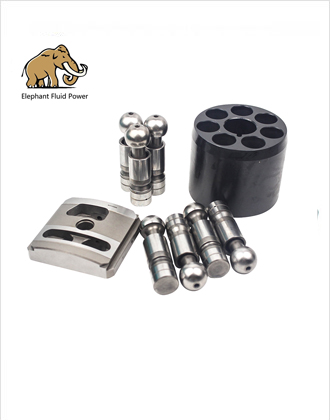
The rotating group is the core sub-assembly of an axial piston pump: cylinder block, piston-shoe assemblies, retainer plate, ball guide, and the block spring that holds the block against the valve plate. It is also the highest-value rebuild item, because it concentrates the pump's precision surfaces in one kit. Buyers searching for "rotating group" or "rotary group kit" for models such as the Kawasaki K3V112, K5V200, Rexroth A4VG125, or Sauer 90R75 are typically mid-repair and need verified compatibility above all else. The cylinder block's bores must hold micron-level roundness; the piston shoes must lap flat against the swashplate; the valve plate's kidney ports must match the original timing. When any of these interfaces is off-spec, the symptoms are immediate — loss of power, slow actuation, heat, and noise — the same failure signatures repair shops report across Hitachi, CAT, and Komatsu main pumps (Hydraulic Pump Supply).
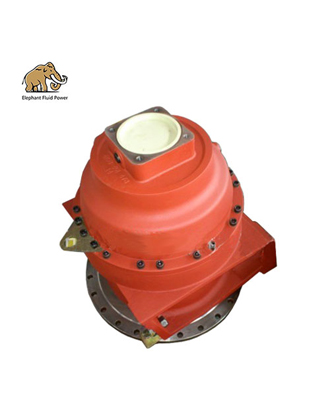
Elephant Fluid Power stocks the complete rotating-group bill of materials as both individual components and matched kits: cylinder blocks and valve plates, piston sets, set plates, shoe plates, ball guides, block springs and disc springs, and full rotating groups for mobile and industrial piston pumps (Elephant Fluid Power). Matching kits from one production system eliminates the tolerance-stack risk that comes from mixing a block from one source with shoes from another — a common hidden cause of premature re-failure in budget rebuilds.
4.2 Swashplates, shafts, bearings, housings, and seal kits
Beyond the rotating group, four component families round out a professional parts program. Swashplate assemblies and saddle bearings carry the variable-displacement mechanism; their wear shows up as erratic flow and control instability. Drive shafts and shaft seals transmit input torque and keep oil in and dirt out — a 4,000 rebuild. Housings and casings become relevant when cavitation or overspeed has damaged the pump body itself, pushing the decision from "repair" toward "major rebuild" territory where repair cost benchmarks of 4,000 for axial piston units apply (Hydraulic Pump Supply). And seal kits — the single highest-turnover item in hydraulic maintenance, with aftermarket kits typically saving 60–65% versus OEM pricing (PNC Parts) — determine how long the repair lasts, because elastomer quality dictates heat and pressure resistance over thousands of hours.
Elephant Fluid Power's catalog spans all four families — swashplate assemblies, shafts, bearings, housings and casings, and seal kits — across the major piston pump brands, supported by its own seal production workshops (Elephant Fluid Power). The practical benefit for a repair shop or fleet is single-source consolidation: one purchase order, one quality system, one shipment, instead of chasing a valve plate from one vendor, a shaft from another, and seals from a third while the machine sits idle at 3,000 per day (Hydraulic Pump Supply).
5. Brand and Model Coverage: Matching Parts to the World's Pump Fleet
5.1 Industrial and mobile pump families
The global piston pump installed base is concentrated in a handful of OEM families, and a credible spare-parts program must speak their language — model by model. Elephant Fluid Power stocks OEM-compatible and new aftermarket replacement parts for pumps from Bosch Rexroth, Vickers, Kawasaki, Hitachi, Denison, Linde, Komatsu, Sundstrand (Sauer), Parker, Oilgear, Eaton, Caterpillar, HAWE, and others (Elephant Fluid Power). The table below maps the most-searched pump families to their typical applications — the same model keywords that drive the highest commercial search traffic in this category.
| Brand | High-demand series (typical search keywords) | Typical applications |
|---|
| Bosch Rexroth | A10VSO 18/28/45/71/100/140, A4VG 28–250, A4VSO 40–500, A11VO 60–260, A2FO, A6VM, A7VO, A8VO | Industrial presses, excavators, concrete pump trucks, mining machines |
| Kawasaki | K3V63/112/140/180, K5V80/140/160/200, K7V63/125/280, M2X/M5X swing motors | Excavator main pumps (Kobelco, Doosan, Volvo, Hyundai, Sany, XCMG) |
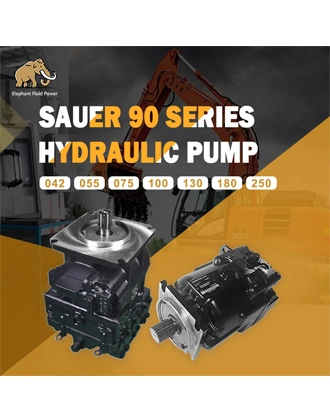
| Sauer Danfoss | 90R30–250, 90M55–250, PV20–27, MPV/M46, H1 series | Closed-circuit propel drives, mixers, rollers, agricultural machinery |
| Eaton Vickers | PVH45–141, PVB5–110, PVQ, PVE, TA19, 4621/5421/6423 series | Industrial power units, mobile equipment, older Vickers fleets |
| Linde | HPR55–160, HPV, B2PV/BPR 35–186, HMV/HMR motors | High-pressure mobile drives, municipal and construction machinery |
| Parker | F11/F12 motors, PAVC, PV/PVP, PVXS series | Industrial and marine hydraulics, fan drives |
| Komatsu Hitachi CAT | HPV95/HPV118/HPV165, SBS80/SBS120/SBS140 | OEM excavator main pumps (PC200/PC400, EX/ZX series, 320/330/345) |
| Denison Oilgear Sundstrand HAWE Yuken | Denison vane & piston series, Oilgear PVWH, HAWE V30D, Yuken A-series | Legacy industrial fleets and specialized machinery |
Model-level depth matters because components are not interchangeable even within one brand family — an HPV091 valve plate does not fit an HPV118, and SBS120 internals do not match SBS140 (Hydraulic Pump Supply). A supplier that lists parts down to the series and displacement level, as Elephant Fluid Power does across its downloadable piston spare parts catalogs (A10VSO, A4VSO, A2FO series catalogs, plus control-valve documentation for A11VO, Sauer 90R/PV, CAT SBS80, Eaton PVH131, and HAWE V30D), removes the single biggest source of ordering error and return-shipping delay (Elephant Fluid Power).
5.2 Excavator and heavy-equipment applications
On the machine side, demand concentrates in excavator hydraulic pumps and parts — the highest-volume application keyword cluster in the category. Elephant Fluid Power manufactures replacement excavator main pumps in the K3V, K5V, and K7V series and supplies compatible parts for machines from Komatsu, Caterpillar, Hitachi, Volvo, Kobelco, Hyundai, Doosan, Daewoo, JCB, Case, and John Deere (Elephant Fluid Power). This machine-level coverage converts directly into search visibility and buyer confidence: a contractor typing "K5V140 parts for Doosan DX300" or "hydraulic pump for JCB JS160" lands on a supplier that stocks the exact rotating group, regulator, and seal kit for that pump.
Beyond excavators, the same piston pump families power concrete pump trucks, wheel loaders, mining dump trucks, roadheaders and tunnel boring machines, drilling rigs, marine winches, and industrial presses. Elephant Fluid Power's technical content addresses these duty cycles directly — including A11VO pump selection for earthmoving, mining, tunneling, and road-construction service — which reflects an application-engineering mindset rather than a box-shifting one (Elephant Fluid Power). For buyers, that means the part arrives with the context to install it correctly the first time.
6. Why Elephant Fluid Power: Three Pillars, One Supplier
6.1 Consistent quality — controlled from raw material to bench test
Quality consistency in piston pump parts is earned upstream. Elephant Fluid Power operates dozens of standard-parts and seal production workshops and cooperates with China's leading non-ferrous metal suppliers, giving it direct control over the two inputs that most determine part life: metallurgy and machining (Elephant Fluid Power). In-house seal production is a particular differentiator — seals are the highest-turnover and most failure-sensitive consumable in any hydraulic rebuild, and controlling their compound and molding in-house removes the variability that plagues multi-vendor kit assembly. The result is a parts range the company describes simply: "We have what others have, and we also have what others do not" — a broader, deeper model coverage than generalist competitors (Elephant Fluid Power).
Consistency is also a process discipline: strict quality control at incoming material, machining, and final inspection stages, backed by an experienced technical team with years of hydraulic system sales, repair, commissioning, and maintenance practice (Elephant Fluid Power, Elephant Fluid Power). For buyers, the operational meaning is batch-to-batch repeatability: the tenth A4VG125 valve plate performs like the first, which is exactly what repair shops need when their own reputation rides on every rebuilt pump that leaves the bench. This is the essence of Tier 1, OEM-equivalent supply — the tier independent analysts recommend as the only safe aftermarket choice for hydraulic components (PNC Parts).
6.2 Fast delivery — 1,300+ part numbers in stock, 1–7 day dispatch
Speed is where Elephant Fluid Power's model differs most sharply from the OEM channel. Where new OEM pumps and some OEM components can carry lead times of 2 to 16 weeks (Hydraulic Pump Supply), Elephant maintains approximately 1,300 kinds of parts in stock and quotes delivery within 1–7 days, with an agreed delivery period fixed by a dedicated sales engineer at order time (Elephant Fluid Power). At a conservative downtime cost of 10,000+** — typically more than the entire parts bill.
Responsiveness extends past the warehouse. The company commits to a 24-hour quotation, a technical response within 2 hours during the warranty period, and comprehensive technical guidance within one working day (Elephant Fluid Power, Elephant Fluid Power). For a repair shop facing a teardown surprise — a scored valve plate discovered on a Friday afternoon — that response cadence is the difference between a Monday completion and a second week of lost revenue. Fast delivery, in other words, is not a logistics slogan; it is a measurable contribution to the customer's bottom line.
6.3 Reasonable pricing — factory-direct value without Tier-3 risk
Because Elephant Fluid Power sells directly from the manufacturer with one-stop service, its pricing avoids the stacked markups of multi-tier distribution (Elephant Fluid Power). Positioned against the market data in Section 3 — quality aftermarket hydraulic components typically saving 40–70% versus genuine OEM (PNC Parts) — a factory-direct Tier 1 supplier sits at the most attractive point on the price/quality curve: OEM-level specifications at aftermarket-level prices, without the gamble of unbranded Tier 3 copies whose early failure erases any upfront saving and can void warranty protections on the rebuilt unit (CJ Plant).
Reasonable pricing also compounds across the relationship. A fleet or repair shop that consolidates rotating groups, seal kits, shafts, swashplates, and housings with one factory-direct supplier gains volume leverage, predictable lead times, and a single accountable quality contact. Independent procurement guides repeatedly advise exactly this hybrid sourcing strategy: quality aftermarket for hydraulic wear components on out-of-warranty machines, OEM only where warranty or proprietary electronics genuinely require it (Excavator Accessories). Elephant Fluid Power's competitive pricing, custom design services, and engineering support are structured for precisely this role (Elephant Fluid Power).
7. How to Choose a Hydraulic Piston Pump Parts Supplier: A 10-Point Checklist
The short answer: choose a specialist manufacturer-stockist that controls its own production, stocks the exact model families you run, ships in days, and answers technical questions in hours. Use the checklist below to score any candidate supplier, Elephant Fluid Power included.
A disciplined supplier evaluation prevents the two most expensive procurement mistakes in this category: buying Tier 3 copies that fail early, and buying correct parts from a supplier too slow to matter. The following checklist distills the criteria that recur across independent buyer's guides and repair-specialist advice (PNC Parts, Hydraulic Pump Supply):
| # | Criterion | What "good" looks like |
|---|
| 1 | Manufacturing control | Own production workshops or direct factory control, not re-labeled trading |
| 2 | Material quality | Named sourcing for critical alloys (e.g., top-tier non-ferrous suppliers) |
| 3 | Model-level coverage | Parts listed by pump series and displacement (A10VSO45, K3V112, 90R100…), not generic labels |
| 4 | Full bill of materials | Rotating groups, valve plates, shafts, swashplates, housings, seal kits from one source |
| 5 | Stock depth | Hundreds to thousands of part numbers on the shelf, stated plainly |
| 6 | Delivery speed | Days, not weeks; committed delivery period at order time |
| 7 | Technical support | Engineering help for model identification and cross-referencing within hours |
| 8 | Quality documentation | Catalogs, control-valve data, and QC process transparency |
| 9 | Warranty & response | Clear warranty terms with a defined technical response time |
| 10 | Pricing structure | Factory-direct or one-stop pricing in the 40–70%-below-OEM band for equivalent spec |
Scored against these ten points, Elephant Fluid Power's profile is deliberately aligned: in-house parts and seal production with top-tier material partners (criteria 1–2), series-level catalogs across a dozen OEM families (3–4), roughly 1,300 stocked part numbers with 1–7 day delivery (5–6), a 2-hour technical response and 24-hour quotation commitment (7, 9), downloadable piston pump and control-valve catalogs (8), and factory-direct one-stop pricing (10) (Elephant Fluid Power, Elephant Fluid Power).
No single criterion is sufficient alone — a cheap part that arrives in six weeks fails the downtime test, and a fast part that fails at 500 hours fails the TCO test. The checklist works as a system, and suppliers that score well across all ten rows are the ones that consistently appear in professional rebuild supply chains. Buyers are encouraged to apply it rigorously, request sample parts and test reports where volumes justify it, and start with a trial order on a high-turnover kit such as a seal kit or rotating group before scaling the relationship.
8. Frequently Asked Questions About Hydraulic Piston Pump Spare Parts
What are the most commonly replaced hydraulic piston pump spare parts?
The highest-turnover components are seal kits, cylinder blocks, valve plates, piston shoe sets, bearings, drive shafts, retainer plates, ball guides, and complete rotating groups. These parts concentrate the pump's precision sliding surfaces and wear progressively, which is why internal leakage, power loss, noise, and heat are the classic symptoms of pump wear (Hydraulic Pump Supply). Elephant Fluid Power stocks all of these, plus swashplate assemblies, housings, block springs, disc springs, and set plates, for mobile and industrial piston pumps (Elephant Fluid Power).
Are aftermarket hydraulic piston pump parts as good as OEM?
Tier 1 aftermarket parts — manufactured to OEM specifications with equivalent materials and tolerances — routinely match genuine-part service life. Documented examples show premium aftermarket excavator pumps delivering 5,000–8,000 operating hours at 40–60% lower cost than OEM (Excavator Accessories). The key is supplier selection: quality varies widely between tiers, so buyers should verify manufacturing control, materials, and warranty rather than shop on price alone (PNC Parts).
How much can I save by rebuilding a pump with quality spare parts instead of buying new?
A parts-based repair typically costs 25–40% of a new pump, and a full rebuild 50–70%, versus 100% for a new OEM unit with a 2–16 week lead time (Hydraulic Pump Supply). For a mainstream axial piston pump, that translates to roughly 1,800 for repair or 4,000 for rebuild versus 8,000 for new replacement — before counting the downtime saved by faster parts delivery.
Which pump brands and models does Elephant Fluid Power cover?
The range spans Bosch Rexroth (A10VSO, A4VG, A4VSO, A11VO, A2FO, A6VM, A7VO and more), Kawasaki (K3V, K5V, K7V), Sauer Danfoss (90 series, PV20–27), Eaton Vickers (PVH, PVB, PVQ, PVE), Linde (HPR, HPV, B2PV/BPR), Parker (F11/F12, PAVC, PV), Komatsu, Hitachi, Caterpillar (SBS series), Denison, Oilgear, Sundstrand, HAWE, and others, for both mobile and industrial applications (Elephant Fluid Power).
How fast can hydraulic piston pump parts be delivered?
Elephant Fluid Power holds approximately 1,300 kinds of parts in stock and typically delivers within 1–7 days, with the delivery period confirmed by a dedicated sales engineer when the order is placed (Elephant Fluid Power). Quotations are provided within 24 hours (Elephant Fluid Power).
How do I identify the correct parts for my pump?
Start with the pump nameplate — the series and displacement (for example, A10VSO45 or K3V112DT) determine compatibility, because components are not interchangeable even within one family (Hydraulic Pump Supply). If the nameplate is missing, a specialist supplier can cross-reference by machine model and serial number. Elephant Fluid Power's technical team provides model-identification support and responds to technical inquiries within hours (Elephant Fluid Power).
Will using aftermarket parts void my machine's warranty?
For machines still under factory warranty, OEM parts are the safe choice. For out-of-warranty equipment — typically 3+ years or 6,000+ hours — quality aftermarket parts are the economically rational option and, under frameworks such as the U.S. Magnuson-Moss Warranty Act, manufacturers cannot void a warranty solely because an aftermarket part was used unless they prove it caused the failure (Hydraulic Pump Supply).
9. Conclusion: Uptime Is a Sourcing Decision
Every data point in this paper converges on one conclusion: the cost of a hydraulic piston pump failure is dominated not by the price of parts but by the days a machine spends waiting for them, and the reliability of a repair is determined not by the logo on the box but by the quality system behind the part. With downtime running 3,000 per machine per day (Hydraulic Pump Supply), OEM lead times stretching to 16 weeks (Hydraulic Pump Supply), and quality aftermarket parts delivering OEM-equivalent service life at 40–70% lower cost (PNC Parts), the rational strategy for fleets and repair shops is a Tier 1 specialist supplier with deep stock and fast response.
Elephant Fluid Power is built to be that supplier: in-house standard-parts and seal production with top-tier material partners for consistent quality; roughly 1,300 part numbers in stock with 1–7 day delivery, 24-hour quotation, and 2-hour technical response for fast delivery; and factory-direct one-stop pricing for reasonable cost — across the full landscape of Rexroth, Kawasaki, Sauer Danfoss, Eaton Vickers, Linde, Parker, Komatsu, Hitachi, CAT, and other piston pump families (Elephant Fluid Power, Elephant Fluid Power).
Get a quote within 24 hours. Send your pump model, part numbers, or photos to Elephant Fluid Power's engineering team via www.heavyequipmentmaintain.com — a dedicated sales engineer will confirm compatibility, price, and a fixed delivery period, so your machine is back at work in days, not weeks.
 French
 Portuguese
 Russian
 German
 Spanish
 Japanese
 Korean
 Irish
Irish
 Greek
Greek
 Turkish
 Italian
 Danish
 Romanian
 Indonesian
 Czech
Czech
 Afrikaans
 Swedish
 Polish
 Basque
 Catalan
 Esperanto
 Hindi
Hindi
 Lao
Lao
 Albanian
 Armenian
 Azerbaijani
 Belarusian
 Bengali
 Bosnian
 Bulgarian
 Cebuano
 Chichewa
 Croatian
 Dutch
Dutch
 Estonian
 Finnish
 Galician
 Georgian
 Haitian
 Hebrew
 Hmong
Hmong
 Hungarian
 Icelandic
 Javanese
 Kazakh
 Khmer
Khmer
 Latin
Latin
 Latvian
 Lithuanian
 Luxembourg
 Macedoniar
 Malagasy
 Malay
Malay
 Maltese
 Maori
Maori
 Mongolian
 Burmese
 Nepali
 Norwegian
 Pashto
 Persian
 Punjabi
 Serbian
 Sinhala
 Slovak
 Slovenian
 Somali
 Samoan
 Tajik
Tajik
 Thai
Thai
 Ukrainian
 Uzbek
Uzbek
 Vietnamese
 Welsh
Welsh
 Yiddish
 Yoruba